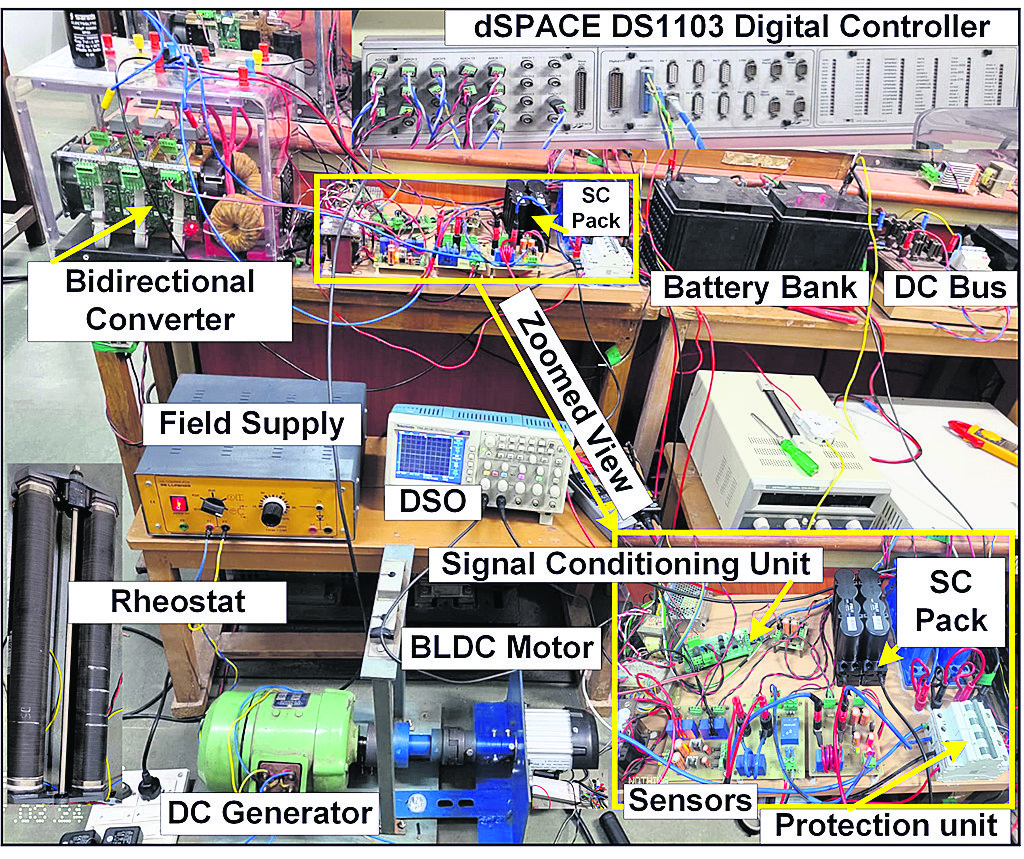
New Delhi/Raurkela: Researchers at the National Institute of Technology (NIT), Rourkela have secured a patent for a hybrid energy-storage system to improve the efficiency and lifespan of batteries used in electric vehicles, officials said.
India is among the largest automobile markets in the world. Dwindling petroleum reserves, coupled with government initiatives, such as the National Electric Mobility Mission Plan and the Faster Adoption and Manufacturing of Hybrid and Electric Vehicles in India (FAME) schemes, have accelerated the adoption of electric vehicles across the country.


According to Monalisa Pattnaik, Associate Professor, Department of Electrical Engineering at NIT-Rourkela, EVs are powered by a battery pack, a large, rechargeable energy-storage system made of thousands of individual cells linked together. Battery packs suffer from low power density, limited cycle life and high thermal stress when exposed to rapid current spikes.
These are particularly serious in cities where the vehicles have to start and stop frequently and have to face sudden and rapid speed increases and decreases, all of which could degrade battery cells. To mitigate these limitations, the battery pack is often paired with a high-power-density supercapacitor to form a hybrid energy-storage system (HESS), Pattnaik said.
Supercapacitors store charge electrostatically at the electrode-electrolyte interface, enabling charge and discharge within seconds and delivering specific power in an order of magnitude higher than that of conventional batteries. They also exhibit an exceptional cycle life, typically exceeding one million charge-discharge cycles with negligible degradation. Consequently, during sudden acceleration, deceleration and regenerative-braking events, the supercapacitor absorbs and supplies the transient power demand, thereby relieving the battery of high-rate current stress and extending its service life.
Pattnaik explained that the battery pack and supercapacitors are usually connected in three ways — passive, semi-active and active. In a passive connection, the two are connected directly, which makes the supercapacitor less capable of responding quickly to changes in power demand. In active connections, there are separate electronic converters that manage the battery and supercapacitor, but these extra components increase complexity and reduce efficiency, she said. To overcome the above prob lems, the NIT-R researchers have developed a hybrid energy-storage architecture that claims to protect the battery from sudden power-requirement surges, efficiently uses supercapacitor energy and minimises the number of components, thereby minimising complexity.
“Our architecture contains three main components, one converter to connect both battery and supercapacitor to the vehicle’s electrical system, an inductor that is placed in the electrical path and a single control system to handle the power flow. Each of these components serves a specific function,” she said. The single converter for both battery and supercapacitor reduces the number of switches and control components, thereby reducing complexity. The inductor protects against sudden surges in current, thereby increasing the life of the battery. The single control system handles both speeding up and slowing down of the vehicle, thereby reducing the hardware requirements, Pattnaik said. The researchers have tested this hybrid system under conditions of sudden brakes, rapid acceleration and deceleration. The system retained stable 48 V voltage, enabled smooth battery current changes and also helped the supercapacitor handle sudden power changes efficiently. “Our design is highly optimised for low-voltage EV platforms operating in the 24 V to 60 V DC range. This includes urban light electric vehicles, such as electric scooters, electric motorcycles, electric rickshaws (e-rickshaws), cargo tricycles and campus or industrial utility vehicles,” Pattnaik said.