
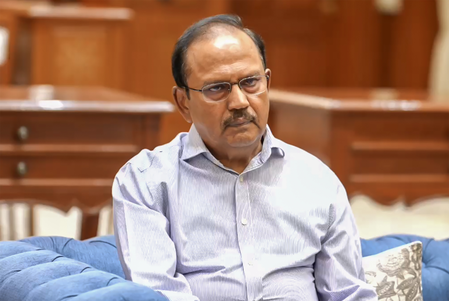
Beijing: National Security Advisor Ajit Doval arrived in Beijing Monday for a two-day visit to take part in the Special Representatives talks on the India-China boundary question with his Chinese counterpart and Foreign Minister Wang Yi.
The talks – scheduled for Tuesday – assume significance as they are being held ahead of Chinese President Xi Jinping’s much-anticipated visit to New Delhi to attend the BRICS summit September 12-13.
They also come at a time when differences over the border and Arunachal Pradesh continue to figure prominently in India-China bilateral ties.
The ties between New Delhi and Beijing came under severe strain after the 2020 Galwan Valley clash and the prolonged military stand-off in eastern Ladakh. But both sides have since taken steps to stabilise relations.
Announcing the Special Representatives (SR) talks at a media briefing here on Monday, Chinese Foreign Ministry spokesperson Lin Jian, however, skirted a direct response to a question about Xi’s visit to India.
Xi’s visit would provide an opportunity for a meeting with Prime Minister Narendra Modi on the sidelines of the summit to discuss initiatives to take forward bilateral ties.
Modi and Xi last met in August 2025 on the sidelines of the Shanghai Cooperation Organisation summit in Tianjin.
On the SRs talks, Lin said Doval and Wang will have an in-depth discussion on the boundary question as well as other bilateral, regional and international relations.
The talks between the Special Representatives are the “main channel for negotiations between China and India on the boundary question, and also an important platform for communication between the two sides on issues of mutual interest,” Lin said.
In August last year, China and India successfully held the 24th round of talks, during which the two sides had candid and in-depth exchanges of views on the boundary question and reached a number of common understandings, he said.
“During this round of talks, the two sides will continue the in-depth communication on the boundary question in the spirit of the common understandings between leaders of the two countries to jointly keep the border areas peaceful and tranquil,” he said.
The two sides will also exchange views on bilateral relations and international and regional issues, he added.
Both Doval and Wang are the designated SRs for the boundary talks mechanism, which was established in 2003 to comprehensively address the dispute of the India-China border spanning 3,488 km.
While success eluded it in resolving the boundary dispute, officials on both sides regard the structured mechanism as a useful tool in addressing the recurring tensions between the two countries on various fronts.
Besides attending the SR talks, Doval will call on Vice President Han Zheng, the External Affairs Ministry said in a press release on the NSA’s visit.
Ahead of Doval-Wang talks, Jaishankar on Saturday reiterated that “peace and tranquillity” along the border areas are a prerequisite for good relations with China.
His comments came amid reports of aggressive posturing by Chinese troops in Arunachal Pradesh’s Upper Subansiri region in recent weeks.
“I think we went through a particularly bad patch between the summer of 2020 and the autumn of 2024, and that was primarily an outcome of the situation in the border areas,” Jaishankar said at the Economic Times World Leaders Forum in New Delhi.
On the reports of stepped-up Chinese military activity near the Arunachal Pradesh border, China’s Foreign Ministry spokesman Guo Jiakun said on August 12 that the China-India border situation is “generally stable at the moment”.
External Affairs Ministry spokesperson Randhir Jaiswal on August 11 said that India considers matters relating to border areas with China as “most serious” and asserted that maintaining peace and tranquillity along the Line of Actual Control is of “utmost importance”, as the state of the frontier will govern the overall trajectory of bilateral ties.
Earlier, New Delhi also trashed Beijing’s criticism of its decision to formally identify 27 places and geographical features in Arunachal Pradesh by their standard names, emphasising that the state is an “inalienable and integral” part of India and nothing can change this “indisputable reality”.
China, which claims Arunachal Pradesh as part of South Tibet, has been releasing its set of names for the region since 2017.
India termed the Chinese move as “vain and preposterous”, asserting that such actions will not alter the “undeniable” reality that the state “was, is, and will” always remain an integral part of India.