
Bhubaneswar/Amaravati/New Delhi: The eastern coastal states of Odisha and Andhra Pradesh closed schools, prohibited sea fishing and kept rescue teams on standby, stepping up precautionary measures ahead of Cyclone Arnab’s expected landfall Wednesday to ensure “zero loss of life and minimal damage to infrastructure”.
The India Meteorological Department (IMD), in its Monday morning bulletin, said a deep depression over east-central and southeast Bay of Bengal has moved westward and has intensified into cyclonic storm ‘Arnab’.
It is likely to cross Andhra Pradesh and Yanam coasts between Bapatla and Visakhapatnam as a very severe cyclonic storm, with maximum sustained winds of 115-125 kmph gusting up to 140 kmph by the forenoon of October 28, it said.
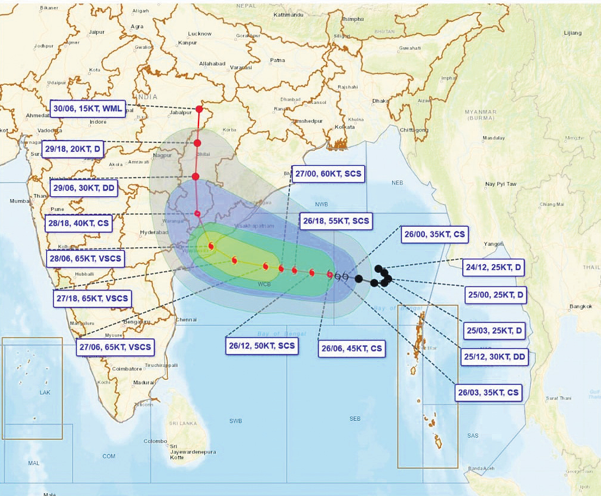

In the national capital, the National Crisis Management Committee reviewed cyclone preparedness, with Cabinet Secretary T V Somanathan saying that besides Andhra Pradesh, Odisha, Telangana, Chhattisgarh and Puducherry, the MHA and the IMD should alert eastern Uttar Pradesh and Bihar, since high rainfall was also expected there.
Somanathan asked agencies to ensure zero loss of life and minimal damage to property and infrastructure and directed them that, in the event of any damage, essential services be restored at the earliest.
The National Disaster Response Force (NDRF) informed the meeting that they have deployed teams, with additional teams on standby.
“Rescue and relief teams of the Army, Navy, Air Force and Indian Coast Guard, along with their ships and aircraft, have been kept ready. Indian Coast Guard has so far shepherded multiple ships/boats to jetties/shore, and the remaining ships have been alerted to return to the coast,” a government statement said.
While the Andaman and Nicobar Islands have ordered the closure of all schools till Tuesday, the Odisha government shuttered schools, colleges, and Anganwadi centres in six southern Odisha districts of Ganjam, Gajapati, Rayagada, Malkangiri, Koraput and Nabarangpur October 28 and 29.
In view of inclement weather conditions, the state prohibited fishing activities in the sea and entry of tourists in the hills, waterfalls and dams in the six districts. Chief Minister Mohan Charan Majhi deputed eight ministers at separate places to monitor pre-cyclone activities.
Rescue teams, comprising personnel of the National Disaster Response Force (NDRF), Odisha Disaster Rapid Action Force (ODRAF), the Fire and Emergency Services and the police, have been pre-positioned at vulnerable areas.
“People living in thatched houses and low-lying areas are being shifted to shelters. Pregnant women are being taken to health centres in advance. Special arrangements are also in place for senior citizens, children, and persons with disabilities,” Odisha’s Disaster Management Minister Suresh Pujari said.
The state government has cancelled leave of its employees in the identified districts, and control rooms have been opened to coordinate relief and rescue operations.
The agriculture department has advised farmers to harvest and safely store crops that are 80-85 per cent mature. Dedicated agricultural helpline numbers have been opened for assistance, the minister added.
Andhra Pradesh Chief Minister N Chandrababu Naidu reviewed cyclone preparedness with officials and instructed them to alert people according to the likely impact of the weather system and take all necessary steps to minimise damage.
He stressed the need to assess the intensity of rainfall, wind speeds and flood flows caused by the cyclone and take appropriate measures based on the evolving situation. Naidu also directed officials to analyse information from previous cyclones and issue timely warnings to farmers and the public to help them take necessary precautions.
Moderate to heavy rainfall was expected in several Andhra Pradesh districts from Srikakulam to Nellore from Tuesday afternoon, accompanied by strong winds along the coast.
Heavy to extremely heavy rainfall was likely October 28 and 29 in the North Coastal Andhra districts, Konaseema, East and West Godavari, Eluru, Krishna, NTR, Guntur, Palnadu, Bapatla, Prakasam and Nellore districts, officials said.
Officials informed the chief minister that arrangements were underway to shift 4,711 identified pregnant women from vulnerable areas to primary health centres, community health centres and hospitals, while all fishermen who had ventured into the sea had returned safely.
Officials estimated that Tandava, Raiwada, Yeleru, Tammileru, Yerrakalava and Tadipudi reservoirs could reach their full storage capacities following the rainfall predicted to be caused by the cyclone.
Naidu instructed officials to ensure adequate stocks of essential commodities at ration shops and restore electricity supply immediately wherever disruptions occurred.
The cyclone is likely to bring heavy rain in several districts of West Bengal from October 28 to 30, the IMD predicted and advised fishermen not to venture into the sea along and off the West Bengal coast from Monday, as squally winds will prevail over the region.
It also warned of possible landslides in the sub-Himalayan district of Darjeeling in the wake of the cyclone. The sub-Himalayan districts of Darjeeling, Kalimpong, Alipurduar and Jalpaiguri could receive heavy rain on October 29 and October 30.