
By Arindam Ganguly
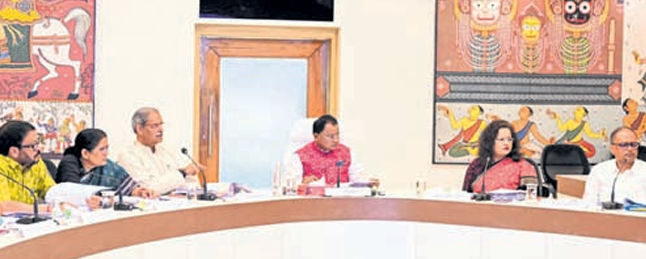
Bhubaneswar: The state Cabinet, headed by Chief Minister Mohan Charan Majhi, Saturday approved the implementation of Mukhya Mantri Janajati Jeevika Mission (MMJJM) 2.0, a flagship tribal livelihood programme, with a financial outlay of Rs 2,995 crore that aims at benefiting over eight lakh tribal and Particularly Vulnerable Tribal Group (PVTG) households across 19 districts.
Briefing media after the 45th Cabinet meeting held at Lok Seva Bhawan, Chief Secretary Anu Garg said apart from the MMJJM 2.0, 10 other proposals also got the go-ahead.
Under MMJJM 2.0, the state government funded the five-year programme (2026-27 to 2030-31); each beneficiary household will receive Rs 30,000 through direct benefit transfer in two instalments for livelihood activities such as agriculture, horticulture, livestock, fisheries, sericulture, forest-based enterprises, handicrafts and rural entrepreneurship.
The programme also provides a Rs 500-crore flexi fund for infrastructure development in PVTG habitations and includes nutritional support and crèche facilities for vulnerable communities, Garg said. The Cabinet also approved the PMAY-(U) BANDHU scheme with a total outlay of Rs 1,615 crore to complement PMAY-U 2.0 and achieve universal urban housing coverage by 2029.
The scheme will support affordable housing projects, rental and transit housing, provide labour incentives to beneficiaries, facilitate affordable housing loans with interest subsidies, and offer financial assistance to displaced urban families. Around 30,000 affordable housing units and 10,000 rental or transit houses are expected to be developed under the initiative, Garg said.
The state government approved amendments to the Odisha Development Authority (ODA) Act, 1982 to enable the creation of Economic Region Development Authorities (ERDAs). The amendment will pave the way for integrated planning and governance of multi-city economic regions, with the Bhubaneswar-Katakata-Puri-Paradeep Economic Region (BKPPER) proposed as the first such economic region after legislative approval.
The Cabinet also approved amendments to the Odisha Goods and Services Tax (OGST) Act, 2017, aligning it with the amended Central GST Act. The changes simplify post-sale discount provisions, expand provisional tax refund benefits to businesses operating under the inverted duty structure, remove the minimum refund threshold for exporters, and are expected to improve ease of doing business while reducing litigation.
To strengthen farm mechanisation, the Cabinet extended the Popularisation of Agricultural Implements, Equipment and Diesel Pump Sets scheme for another five years (2026-27 to 2030-31) with an allocation of Rs 2,200 crore. The scheme is expected to benefit 3.79 lakh farmers through subsidies on tractors, power tillers, harvesters and other farm machinery.
During its previous phase, over 2.54 lakh farmers had availed assistance. Multiple irrigation infrastructure projects were also among the proposals approved by the Cabinet.
Two packages under the Integrated Anandapur Barrage Project were approved at execution costs of Rs 145.71 crore and Rs 112.52 crore, respectively, to develop underground pipeline irrigation systems covering more than 12,200 hectares of agricultural land in Baleshwar.