
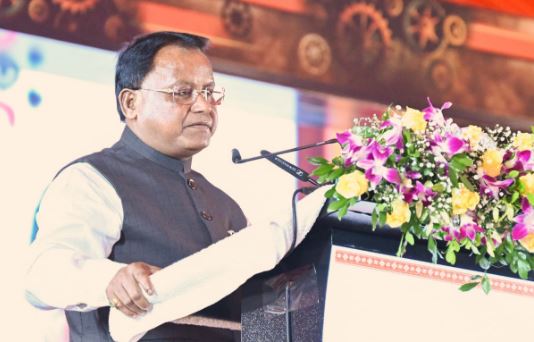
Bhubaneswar: Odisha Chief Minister Mohan Charan Majhi Saturday said the state’s urbanisation rate is expected to more than double to 40 per cent by 2036, and asserted that the BJP government has already commenced developing state-of-the-art infrastructure and establishing modern institutions to support this growth.
CM Majhi was addressing a gathering after inaugurating the National Urban Conclave-2026 in Bhubaneswar in the presence of Union Minister of State for Housing and Urban Affairs Tokhan Sahu.
“While Odisha’s current urbanisation rate stands at 17 per cent, it is projected to increase to 40 per cent by 2036. Work has already commenced on developing state-of-the-art infrastructure and establishing modern institutions to support this growth,” the CM said.
Majhi said Odisha has emerged as a key growth engine for the nation, and highlighted his government’s aim to build a prosperous state with a USD 500 billion economy by 2036, when Odisha completes 100 years of statehood.
He said the country’s urban population is projected to surpass its rural population by 2047.
Therefore, the goal is to make cities inclusive, technology-driven, and well-equipped with modern amenities, he said.
The chief minister said extensive opportunities have been created in the state across sectors like industries, ports, tourism and services to accelerate urban development and economic progress.
He said Odisha has already received investment proposals totalling Rs 23 lakh crore, while the implementation of over 200 industrial projects, involving an investment of Rs 3.5 lakh crore, has been completed.
Under the guidance of the central government and NITI Aayog, the ‘Bhubaneswar-Cuttack-Puri-Paradip Economic Region’ (BKPPER) is being established, the chief minister noted.
Majhi said that new satellite townships are being developed through the expansion of Bhubaneswar and Cuttack.
Furthermore, 28 new NACs (notified area councils), seven municipalities, and one municipal corporation have been established.
He also highlighted the success of the state government’s urban welfare schemes.
On the ‘Right to Walk’ theme of the conference, the chief minister said that safe footpaths, crossings, and public spaces are essential components of urban transport planning.
The state’s CRUT (Capital Region Urban Transport) network, which began in 2018 with 200 buses, now operates 770 buses across 138 routes, connecting seven cities and serving 3.5 lakh passengers daily, he said.
On the occasion, Majhi launched 26 e-buses under the ‘PM-eBus Sewa’ initiative.
Chief Secretary Anu Garg said that the ‘Drink from Tap’ project, which originated in Puri, has now been expanded to 11 cities, and additionally, pure drinking water is being supplied via pipelines to households across 114 urban areas in the state.
NITI Aayog CEO Anurag Jain said, “By 2047, 50 per cent of India’s population will reside in urban areas, and this segment will contribute to 75 per cent of the country’s GDP.”
He said it was crucial for urbanisation to take place in a well-organised and planned manner.
While well-conceived and planned urbanisation accelerates a nation’s economic development and progress, uncoordinated and chaotic urbanisation gives rise to various serious problems, he added.
PTI