
ARINDAM GANGULY, OP
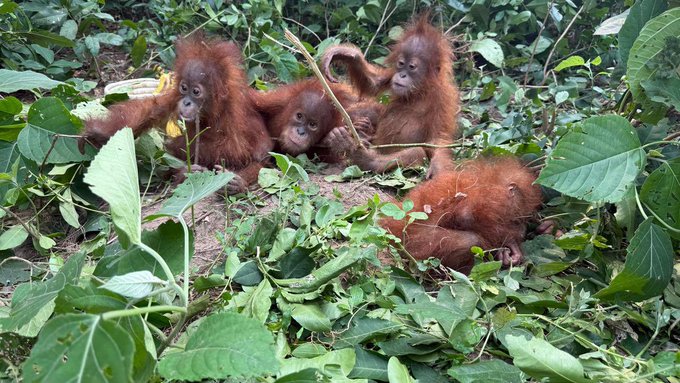
Bhubaneswar: The discovery of five baby orangutans abandoned in a forest in Baleshwar has put Odisha’s wildlife trafficking network under the scanner, with investigators examining whether the state is increasingly being used as a transit corridor for the illegal movement of exotic and indigenous wildlife.
The Odisha Police Special Task Force (STF), in coordination with the Wildlife Crime Control Bureau (WCCB), is investigating how the animals reached the state and whether their movement was part of an organised wildlife-trafficking network.
The five orangutans, which are not native to India and are naturally found in the forests of Borneo and Sumatra, were rescued from the Bhograi area of Baleswar and shifted to Nandankanan Zoological Park.
Forest Minister Ganesh Ram Singh Khuntia said the agencies are examining both international and local links to establish how and through whom the apes reached the state.
Baleshwar DFO Pratik Prakash Indulkar said, “We suspect that the orangutans may have originated in Malaysia and could have reached Kolkata by ship before being transported further.”
National Tiger Conservation Authority former member secretary Anup Nayak said, “Odisha has emerged as both a significant transit and source region for illegal wildlife trade, with leopard skins, claws and bones, pangolins and their scales, elephant tusks and bones, freshwater tortoises and birds such as parakeets, hill mynas and munias among species targeted by traffickers.”
“Red sanders, illegally transported from Andhra Pradesh to the Northeast, also pass through Odisha via road networks.
Most wildlife consignments originating from Odisha are believed to be routed towards Kolkata,” Nayak said.
“Illegal wildlife trafficking through sea routes connecting Thailand, Myanmar and Bangladesh can no longer be ruled out; it has become a disturbing reality,” he said. Nayak also flagged the possibility of exotic species being brought into India from Southeast Asia.
Former Principal Chief Conservator of Forest and Head of Forest Force Odisha Debabrata Swain described the incident as a possible organised wildlife-smuggling operation.
“This appears to be a serious case of organised wildlife smuggling. The fact that the orangutan cubs were found abandoned in a forest raises the possibility that they were being transported through Odisha as part of a larger smuggling network,” Swain said.
Former PCCF (Wildlife) Susanta Nanda said that the trail must be reconstructed scientifically—from CCTV footage and vehicle movements to mobile-phone records, financial transactions and the interrogation of those involved,” he said.
Wildlife activist Akash Ranjan Rath said, “It is an established concern that several wildlife species have been trafficked through or from Odisha in the past.
We have personally found sloth bear cubs being illegally kept around Khordha, indicating an active trafficking network in the region. Bhitarkanika is also emerging as a concern for reptile trafficking.”
Odisha has witnessed several major wildlife seizures in recent years. In March 2024, DRI officials rescued 351 Indian tent turtles at Manguli toll plaza in Kataka.
In September 2024, 490 freshwater turtles were seized in Malkangiri, followed by 1,078 turtles near Motu in August 2025.
In March 2025, Customs officials at BPIA Airport intercepted a major wildlife smuggling attempt and seized exotic reptiles including snakes, chameleons, tortoises and monitor lizards.
In August 2026, the Khariar Forest Division in Nuapada district arrested three persons and rescued a live pangolin during a crackdown on wildlife smuggling along the Odisha-Chhattisgarh border.