

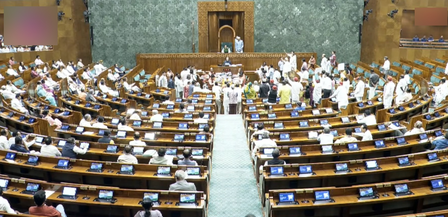
New Delhi: The Winter session of Parliament is likely to begin in the first week of December, with the proposed delimitation-linked women’s reservation bill emerging as the government’s biggest legislative priority amid an increasingly confrontational political atmosphere over the Special Intensive Revision (SIR) of electoral rolls.
The government is keen to push through the Constitution amendment bill, which seeks to expand the Lok Sabha’s strength from the existing 543 seats to a maximum of 850 through delimitation, paving the way for the implementation of 33 per cent reservation for women in Parliament and state legislatures ahead of the 2029 general elections.
Sources familiar with the discussions told PTI that the first week of December was emerging as the likely window for the session, with the possible dates discussed at the highest levels of the government.
However, securing the numbers for the crucial legislation could prove challenging. The bill requires a two-thirds majority in the Lok Sabha, or 361 votes in the present 543-member House. With three vacancies, the House has 540 members at present.
The ruling NDA has 320 members and would need the support of opposition parties to cross the threshold.
The political challenge extends beyond numbers. Opposition parties, which have stepped up their campaign against the SIR and are demanding Chief Election Commissioner Gyanesh Kumar’s resignation, are expected to take their protests to Parliament, potentially setting the stage for another stormy session.
A ruling alliance MP said debate and voting on a Constitution amendment bill would not be possible unless the House functioned in an orderly manner.
The government, however, appears confident of overcoming the numerical hurdle. A senior government functionary Thursday expressed confidence that the bill would be passed with a margin of 15 to 18 votes.
Meanwhile, the government’s decision to keep the Monsoon session alive without formally proroguing it has further fuelled speculation about the timing and conduct of the next sitting.
The Monsoon session was adjourned sine die (for an indefinite period) August 13 and has remained unprorogued for 94 days, surpassing the previous record of 87 days set in 2008.
The arrangement had kept open the possibility of an extended or special sitting to take up the proposed constitutional amendment at short notice.
An extended sitting of the existing session requires a minimum notice of two days, while convening a fresh session requires at least 14 days’ notice.
The government is learnt to be exploring a formula under which Lok Sabha seats would be increased by 50 per cent across states to address concerns, particularly among southern states, over the implications of delimitation.
The proposed framework is also understood to retain the existing inter-state share of seats based on the 1971 Census, though no final decision has been taken.
The proposed legislation failed to secure the requisite numbers during a special sitting of Parliament April 17, making its fate in the winter session a key political and legislative test for the government.
The Constitution does not prescribe a specific timeframe for proroguing a House after it has been adjourned sine die.