
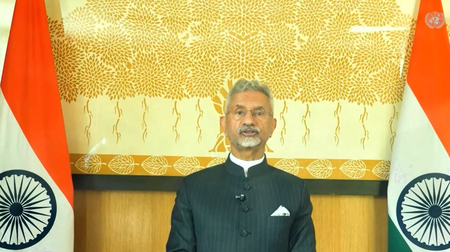
New Delhi: India and China have an interest in maintaining a “stable” bilateral relationship, External Affairs Minister S Jaishankar said Saturday while asserting that the state of the border would naturally determine the state of the ties.
The external affairs minister said India will have to do business with the entire world, including China, with confidence while continuing to stand its ground as it did along the frontier.
“I think we went through a particularly bad patch between the summer of 2020 and the autumn of 2024, and that was primarily an outcome of the situation in the border areas,” he said at the Economic Times World Leaders Forum.
Jaishankar said that “at the end of the day, peace and tranquillity in the border areas is a prerequisite for good relations, and the state of the border, to a very large measure, naturally would determine the state of the relations.”
The external affairs minister said the countries are “very big economies” and both countries are markets to each other in many ways as well as part of a supply chain.
“The world is competitive. We must build up our strengths. We have to do business with the entire world. That includes China too. But it is important we deal with them confidently and we stand our ground as we have stood in the the border,” he said.
Jaishankar’s remarks came in response to a question on the state of India-China ties.
India and China rolled out a series of measures in the last over one year to rebuild their relationship after it came under severe strain following the deadly Galwan valley clashes in 2020 and the subsequent military face-off that lasted for more than four years.
In October 2024, the two sides firmed up a disengagement pact for Depsang and Demchok, the last two friction points in eastern Ladakh. Days after the agreement was finalised, Prime Minister Narendra Modi and Chinese President Xi Jinping held talks in Kazan and took a number of decisions to improve the ties.
In August last year, Prime Minister Modi travelled to the Chinese city of Tianjin to attend the annual SCO summit. PM Modi and Chinese President Xi Jinping held extensive talks on the sidelines of the SCO (Shanghai Cooperation Organisation) Summit.
Jaishankar also extensively delved into economic aspects of India-China relations.
“In many ways, we are markets to each other. We are, you know, part of a supply chain. They (China) industrialise much faster and much bigger and much earlier,” he said.
The external affairs minister rued that India could have taken the opportunity to deepen manufacturing and industrialisation over half-a-century back.
“I would also say, at a political level, at a strategic level, both of us have an interest in maintaining a certain, I would say, stable relationship,” he said.
Jaishankar also said that India has taken up with China issues relating to businessmen facing visa problems.
The external affairs minister said India must work on its strengths.
“We develop our strengths, which unfortunately, as I said, from the 1960s for half a century we did not do. We have to make up for the shortcomings,” he said.
“I think a stronger, a more ‘Atma-Nirbhar’ (self-reliant) India, a more industrialised India, a stronger and a more manufacturing India will be able to actually compete with China as it will with other major countries of the world.
To a question on US-China relations that has been billed as G2, Jaishankar called for looking at it “with some caution”.
“If you look at the US-China relationship, I think at its heart is a fundamentally competitive relationship, but as is often the case, it can also be collaborative in certain matters. It can be indifferent in certain sectors. So it is not that they will compete on every issue in every geography in every time frame. So it’s a very complicated relationship as is natural.
“So, where we are concerned, I will, as I said, for me the guiding principle Indian national interest..it’s a relationship which we will monitor and assess from the manner in which it serves us best,” he said.