
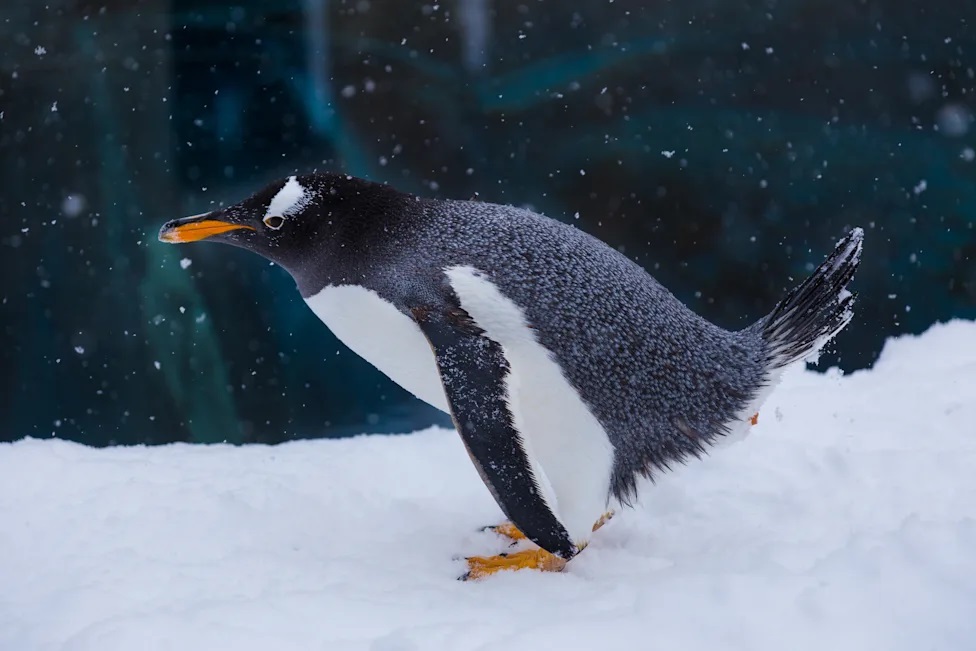
Washington: Penguin droppings are helping microscopic algae flourish across Antarctica’s snowy coastline, creating colourful blooms that absorb more sunlight and could accelerate snowmelt.
A new study suggests that nutrients deposited by penguins and other seabirds may contribute to the expansion of ice-free areas along the Antarctic Peninsula. Snow algae produce striking red and green patches across the Antarctic landscape. Their colour influences how much solar energy the snow absorbs. Red algae-covered snow absorbs about 20% more sunlight than clean white snow, while green algae-covered snow absorbs roughly 40% more, potentially intensifying local melting as temperatures rise.
When nutrients are plentiful, snow algae produce chlorophyll and other green pigments that support photosynthesis and active growth during the short Antarctic summer.
Under harsher conditions or when nutrients become scarce, they can produce red protective pigments that shield their cells from intense sunlight while slowing growth.
Researchers found that phosphate, a nutrient abundant in penguin droppings, may help explain why some algae remain green instead of entering this protective red stage.
To investigate the relationship, scientists collected red and green snow samples along the West Antarctic Peninsula, covering five degrees of latitude.
Their sampling included coastal locations both with and without penguin colonies. In the laboratory, lead author Elise Ryan and her colleagues examined the samples under microscopes and analysed their pigments and nutrient concentrations.
Snow dominated by green algae contained substantially more phosphate than samples dominated by red algae, supporting the idea that nutrients from seabird droppings encourage green blooms.
Penguins obtain nutrients from their marine diets and transfer them onto land through their droppings.
Other seabirds, including skuas, contribute to the process by depositing nutrient-rich waste across coastal snow.
By supporting larger populations of actively growing algae, this natural fertilisation process darkens the snow and increases its absorption of sunlight. The resulting warming could reinforce existing melting and contribute to the expansion of ice-free coastal terrain.
Ryan warned that biological darkening is an important factor in predicting Antarctica’s changing landscape.
Without accounting for the interaction between wildlife, nutrients and snow algae, scientists may underestimate the rate of coastal snowmelt and the expansion of ice-free areas.