
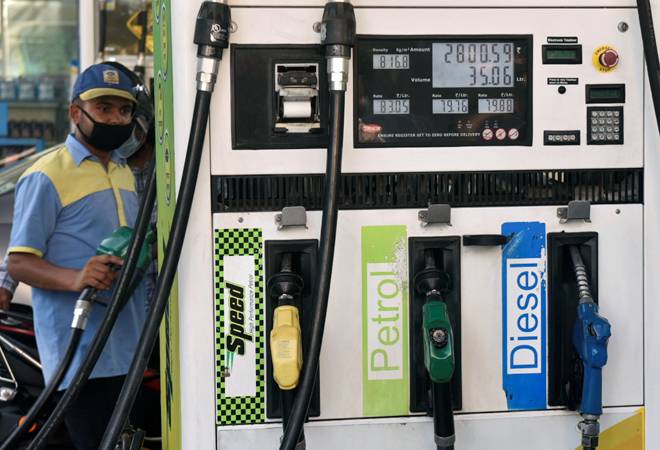
New Delhi: Petrol and diesel prices were hiked by about 90 paise per litre Tuesday, marking the second increase in fuel rates in less than a week after state-run oil firms ended a nearly four-year freeze on revisions.
The increase pushed petrol prices in New Delhi to Rs 98.64 per litre from Rs 97.77, while diesel rose to Rs 91.58 from Rs 90.67, according to industry sources.
On Friday, petrol and diesel prices were raised by Rs 3 per litre Friday for the first time in more than four years, as surging global crude prices following the Iran war forced state-run fuel retailers to pass on part of their mounting losses after months of holding rates steady through key state elections.
Rates vary across states due to differences in value-added tax.
On May 15, compressed natural gas (CNG) prices were also raised by Rs 2 per kg in cities, including Delhi and Mumbai. On Sunday, CNG prices were again hiked by Re 1 a kg.
Global crude prices have surged more than 50 per cent since US-Israeli strikes on Iran February 28 and Tehran’s retaliation, disrupting flows through the Strait of Hormuz, a key artery for global oil shipments.
Despite the surge, retail fuel rates were kept frozen at two-year-old rates as part of what the government said was an effort to shield price-sensitive consumers from higher global energy costs. But the opposition parties saw political motives behind the move as key states went to polls.
The Rs 3 a litre increase Friday followed the completion of elections and the ruling Bharatiya Janata Party (BJP) expanding its influence after winning three of five states, including West Bengal.
That increase covered just a fifth of the desired hike required to level rates with cost.
On Monday, Sujata Sharma, Joint Secretary in the Ministry of Petroleum and Natural Gas, had stated that the May 15 hike had cut losses by a fourth and that oil companies were still incurring about Rs 750 crore a day loss.
After Tuesday’s increase, petrol and diesel prices are now the highest since May 2022.
Prices have remained on freeze since April 2022, but for a one-off reduction by Rs 2 a litre each on petrol and diesel in March 2024, just before Lok Sabha elections. Rates were last hiked in April 2022.
Petrol in Mumbai now costs Rs 107.59 a litre and diesel costs Rs 94.08 per litre. In Kolkata, petrol now costs Rs 109.70 per litre and diesel Rs 96.07, while in Chennai, prices increased to Rs 104.49 for petrol and Rs 96.11 for diesel.
Industry sources said the price hike is modest relative to the rise in crude prices and still leaves retailers absorbing significant losses.
According to Crisil, losses on petrol were about Rs 10 per litre and Rs 13 on diesel after May 15 increase.
The two price increases follow excise duty cuts announced in March and come as the government rolls out measures to curb fuel consumption and contain the country’s oil import bill.
Prime Minister Narendra Modi last week urged fuel conservation, work-from-home practices and reduced travel as higher energy prices strain India’s foreign exchange reserves and threaten to widen the current account deficit for a third straight year.
Some state governments have already instructed departments to limit travel, avoid physical meetings and operate with reduced office staffing.
Private fuel retailers had already increased pump prices. Nayara Energy, the country’s largest private fuel retailer, in March, raised petrol prices by Rs 5 per litre and diesel by Rs 3, while Shell increased petrol prices by Rs 7.41 and diesel by Rs 25 per litre from April 1. In Bengaluru, Shell sells petrol at Rs 119.85 per litre and diesel at Rs 123.52.
Domestic cooking gas LPG prices were raised in March by Rs 60 per cylinder, but they are still way lower than the actual cost. Oil companies are losing Rs 674 per 14.2-kg cylinder of LPG.
Industry sources said the price hike appears calibrated – enough to partially ease margin pressure on oil companies without creating a major inflationary shock.
The increase, however, will have some impact on inflation, they said.
India’s retail inflation, measured by the Consumer Price Index (CPI), rose to 3.48 per cent in April 2026 from 3.40 per cent in March, while wholesale price inflation (WPI) surged to 8.3 per cent, a 42-month high, driven by a sharp rise in fuel and energy prices amid elevated global crude oil rates.