
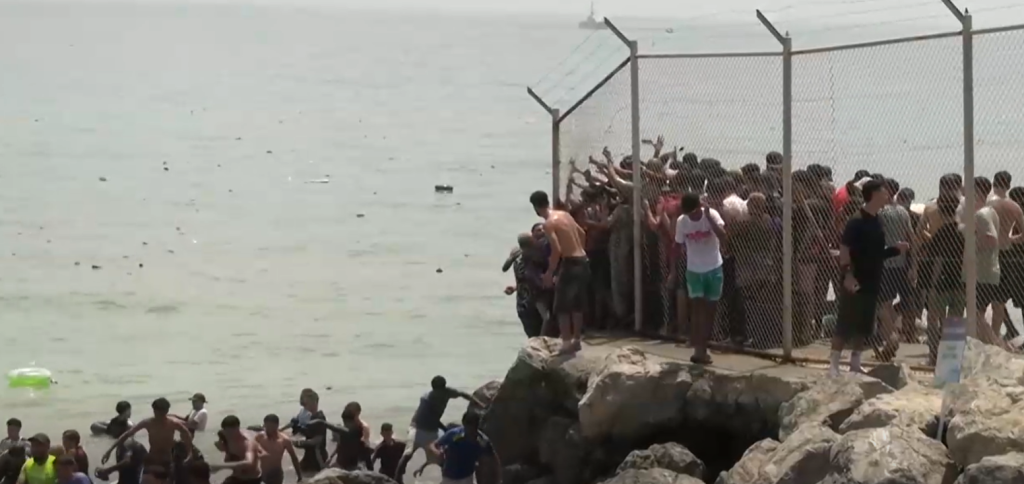
A colossal tragedy on a sea has given fillip to ultra-right politics in Italy, Germany and the UK. The three countries are now witnessing a frenetic battle among far-right parties to score over one another and stake their claims for being the “true” radical force on the right. The recent death of over 70 people, including children, most of whom drowned or were crushed as they joined tens of thousands of others in attempting to swim from Moroccan waters to the Spanish exclave of Ceuta, has not made headlines the way it should have. But the moment US President Donald Trump decried the attempted exodus as an “invasion,” far-right parties in Europe have started exploiting the grave humanitarian crisis to serve their own political agendas. In fact, the issue has triggered a raging debate on whether the known far-right outfits are radical enough and led to the emergence of forces claiming themselves to be the real far-right.
What has caused the tragedy is misinformation on social media and exhortations to people reeling under poverty, low wages, joblessness and uncertain future in Morocco to cross the sea over to the Spanish exclave, taking a cue from a Spanish Supreme Court ruling that migrants arriving by sea could not be summarily turned back. Moroccan authorities seemingly did little to prevent the chaotic exodus. The Spanish government, fighting ongoing wildfires, was caught unawares. However, it mobilised its forces quickly and persuaded the vast majority of the 60,000 or so, who had crossed into Ceuta, to return voluntarily across the border within 48 hours.
But the real political drama, fraught with far-reaching global consequences for issues of migration, attacks on minorities, genocide and LGBTQ rights, have started thereafter. The first response came from Italy’s Prime Minister Giorgia Meloni who sought to demonstrate her hard line on irregular migration by temporarily suspending Rome’s Schengen agreement with Madrid, though Ceuta has never been included in Schengen, and Italy and Spain share no border. Along with Germany’s chancellor, Friedrich Merz, she was also among 22 signatories to a letter sent to the European Commission, suggesting that the liberal migration policies of the Spanish Prime Minister, Pedro Sanchez are undermining Europe’s security.
The real purpose of such posturing is to address a domestic audience. Merz, for example, faces a major challenge from the far-right Alternative for Germany (AfD) in three coming state elections, while Meloni is confronted with the emergence of a new party that threatens her own rightist stand. The zeal of such forces to weaponise the immigration issue is evident from the mob hysteria that far-right leaders are trying to whip up. The AfD’s leader, Alice Weidel, claimed that the “likely destination” for most of those entering Ceuta was Germany. They are doing this despite the fact that the number of irregular border crossings into Europe declined by 40 per cent in the first half of 2026 compared with last year. This has been possible partly as a result of better-coordinated preventive strategies.
Italy is now being swept by the rhetoric of Roberto Vannacci, the founder of a new rabid far-right outfit, National Future, who accuses Meloni of being rather soft on migrants. The two will be locked in a contest for the prime ministerial post a few months away. Vannacci has become a member of the European Parliament arguing that Meloni’s coalition government has sold out its far-right supporters through not being extreme enough. The “true right,” according to him, should be pro-Putin and anti-Ukraine, anti-EU, and committed to restoring the “cultural homogeneity” of Italy through the expulsion of immigrants and their descendants.
Polls are now placing National Future just behind Forza Italia, the second-biggest party in Meloni’s hard-right coalition, and ahead of its third main component, Matteo Salvini’s League. Meloni is indeed worried over Vannacci’s rapid rise. Her own neo-fascist Brothers of Italy party is under attack from Vannacci for “betraying the cause of the radical” forces.
What is happening in Italy is being echoed in the UK as well where Rupert Lowe’s Restore Britain party is steadily eating into the support base of the far-right Reform UK. Right-wing radical forces are spreading their wings across the globe with their hate-filled political agenda directed against minorities, migrants, women and LGBTQ groups. India is increasingly coming under its sway. This is posing a threat to democracy as dissent is being ruthlessly curbed through government fiats and social media trolls.
The situation is getting even more complicated with the emergence of an upgraded and more intolerant version of far-right parties. When viewed on a larger canvas, this call for an even more acute right in Europe is getting shriller and it is a direct reaction to the migration. This may not be all bad.