


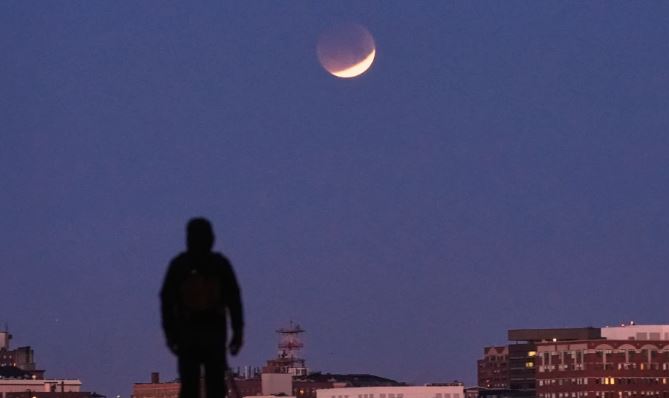
New Delhi: The moon is set to take centre stage this week as Earth’s shadow sweeps across its surface in a near-total lunar eclipse visible from large parts of the world.
Nearly 96% of the moon’s surface will be covered by Earth’s shadow Thursday night into Friday, making it an especially deep partial eclipse. The event will be visible, weather permitting, across North and South America, Europe, Africa and the Middle East, giving billions of people an opportunity to watch at least part of the celestial display.
Will the lunar eclipse be visible in India?
According to reports, this partial lunar eclipse will not be visible from India, including Delhi. India will miss the celestial event entirely, while observers across much of North and South America and parts of Europe and Africa will be able to watch it.
Parts of the eclipse will also be visible from western Asia, the Pacific, Atlantic and Indian oceans and Antarctica, according to Time and Date.
How will the lunar eclipse unfold?
During a lunar eclipse, Earth passes between the sun and moon, casting its shadow across the moon. The partial eclipse will last more than three hours, while the entire event, including the passage through Earth’s faint outer shadow, will stretch for about 5½ hours.
Because the alignment will not be perfect, the moon will not be completely obscured and the event will fall short of a total lunar eclipse, often known as a blood moon.
The eclipse will be visible at different stages depending on location. In parts of Europe, Africa and the Middle East, the moon will set before the eclipse is complete. It will rise during the event in Hawaii and parts of the eastern Pacific, as well as northwestern areas of the United States and Canada.
People in space may also get a view. The eclipse could be visible from the International Space Station, where seven astronauts are living, as well as China’s orbiting outpost.
“This is a great time to be part of the space programme, right? We’re not slowing down,” NASA astronaut Jack Hathaway told The Associated Press from the International Space Station last week.
The eclipse also comes at a time of renewed interest in lunar exploration, following NASA’s Artemis II mission, which carried astronauts on a record-breaking lunar flyby in April as part of plans for future crewed missions to the moon.
This will be the second lunar eclipse of the year and the fourth eclipse overall. A total lunar eclipse occurred in March and was visible across parts of the Americas, Australia and eastern Asia.
The next total lunar eclipse is expected on New Year’s Eve 2028, when Asia and Australia will have the best views. Stargazers in North and South America will have to wait until 2029 for their next opportunity to see a total lunar eclipse.
PNN & Agencies