
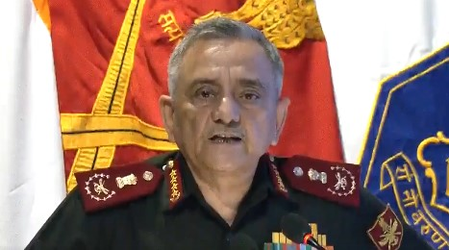
New Delhi: Acknowledging that China presents a long-term and comprehensive challenge to India, former CDS Anil Chauhan Saturday said the boundary issue with the northern neighbour remains unresolved, and there’s no mutually agreed definition even on the Line of Actual Control, but New Delhi’s ties with Beijing “cannot be held hostage to only boundary issues.”
Delivering a lecture on ‘Threats and Challenges to India’s Security’ at an event hosted at the Teen Murti Bhawan complex here, he underlined that border stability requires “vigilance, credible capabilities, clear agreements and consistent adherence to them.”
His comments come days after National Security Advisor Ajit Doval held talks in Beijing with Chinese Foreign Minister Wang Yi focusing on delimitation of the frontier and sustaining work on trans-boundary cooperation. Held under the framework of Special Representatives dialogue, the Doval-Wang talks came weeks before Chinese President Xi Jinping’s anticipated visit to India for the upcoming BRICS summit (September 12-13).
Gen Chauhan (retd) in his address also referred to a report in Saturday’s newspaper which talked about likely “establishment of hotlines”, as well as “corps commander-level talks” in the Northeast, and described it as “a welcome development”.
Also Read : Census: Population enumeration in 4 poll-bound states from Dec 1, 2026 to Jan 4, 2027
In his address, he enumerated several challenges that India faces and how it should manage them.
“As regard our northern neighbour, it presents absolutely different and more long-term and comprehensive challenge,” he underlined.
“The boundary issue remains unresolved, and there’s no mutually agreed definition even on Line of Actual Control. Differences in perception, combined with infrastructure development and forward military presence creates the possibility of friction and escalation,” he said.
Emphasising that China and India are two major Asian powers, large economies and civilisational states, the former general officer said the relationship between the two countries cannot be held hostage to only boundary issues.
He said that since both countries cooperate and compete as well and hold differing views on regional and global order, there was a need to engage with China.
“That’s what we’re doing as part of SCO, and now as part of BRICS. And, the future of Asia will depend substantially on how India and China manage this simultaneous rise,” he added.
In his address, he also identified instability in multiple countries in the Indian neighbourhood as a “threat” which must be managed too.
Gen Chauhan (retd) also touched upon deep flux in global order and said India must be prepared for any eventuality.
“The first and the biggest challenge before us in this global geopolitical flux. This uncertainty which is prevailing, the global security order. The old balances have weakened, while structures of a new order are yet to emerge fully.
“Some people call it ‘disorder’ and maybe this disorder prevails for sometimes, durable kind of a disorder. This will be a major challenge for us,” he said.
Alignments become issue-based and transactional in such an environment, the former CDS cautioned.
“It’s difficult to place countries permanently into categories of friends and adversaries… But today, everything is changing very, very fast. A partner in trade may be a competitor in technology. A security partner in one theatre may hold different position in the different theatre. Indo-Pacific could be absolutely different from your Eurasian continent. Because of all this, there is an increased propensity amongst nations to use force,” he added.
“…and international law remains important, but its enforcement is uneven, and powerful states frequently interpret rules through the lens of national self-interest. Nation-states are becoming more and more self-centric,” Gen Chauhan (retd) said.
“India must be prepared for all eventualities. Self-reliance reduces vulnerability,” the former CDS said.