
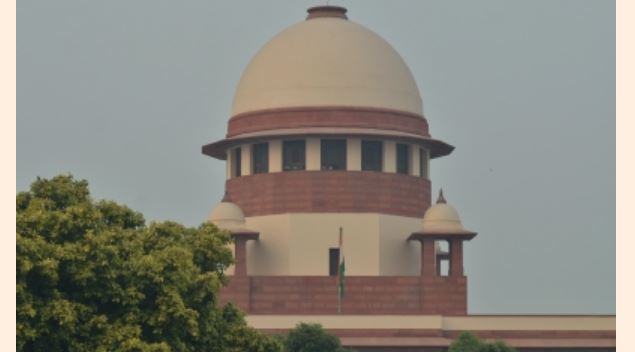
New Delhi: The right to walk on a demarcated footpath is a fundamental right, the Supreme Court has ruled.
In a significant verdict, the top court held that this right shall have priority over motorised vehicles on demarcated paths and it forms part of the right to movement guaranteed under Article 19 (1) (d) and other fundamental rights including Article 21 (right to life and liberty).
A bench of justices PS Narasimha and AS Chandurkar held that a citizen’s fundamental right to walk on a demarcated footpath is primary and shall have priority over movement by motorised vehicles.
The declaration by the top court came in an unfortunate motor accident compensation case where a father lost his five-year-old son while taking him to school.
“The right to walk is a fundamental right under Part III of the Constitution. It is integral to the right to movement guaranteed under Article 19(1)(d), read with Article 19(1)(a), Article 19(1) (b), Article 19(1) (c) and Article 21 of the Constitution of India. The fundamental right to walk will take within its sweep the right to demarcated footpaths. These rights are primary and shall have priority over movement by motorised vehicles,” the bench ruled.
It held that the fundamental right to walk on demarcated footpaths has a correlative duty and “If the road exists, there is a duty to ensure that there are demarcated and well-maintained footpaths for walkers”.
The bench said the duty bearers are the urban development authorities, municipal corporations, municipalities and even panchayats, who must endeavour to demarcate, construct, maintain, and safeguard footpaths and other necessary pedestrian infrastructure, as walking is integral to life.
“The violation of the right to walk on demarcated footpaths will entitle the citizens to invoke constitutional and legal remedies against duty bearers for restitution and compensation. This remedy is independent of the remedies that are available under the Motor Vehicles Act, 1988,” it said.
It directed the registry to send the judgement to the central ministries and law commission for initiating the necessary legal framework.
The top court said human beings have started walking long before wheels were put on the path and the primary right of movement under Article 19(1)(d) is the Fundamental Right to Walk, a right that precedes the right to move on wheels and this precious right must extend to guaranteeing access to safe and well demarcated footpath.
Also Read : SC refuses to accord urgent hearing on pleas related to NEET-UG 2026
“The citizen’s fundamental right to walk on a demarcated footpath is primary and shall have priority over movement by motorised vehicles,” it said, adding that accidents like in the instant case continue to occur, perhaps they are inevitable till citizens restructure their rights regime as regards access to roads and recognise their correlative duties.
“Till then, we will continue to cope with these tragedies by routinely transforming them into FIRs and motor accidents claims,” it said, while pointing out that it is rather strange that people failed to focus on recognizing and securing this “right to walk”.
“It could also be elitism to start with, for machines with wheels were only for the rich, but as economies progressed and cheaper motor vehicles were introduced, the entire spectrum of motorised transportation dominated the roads, pushed aside the walkers to the extent that they are treated as a nuisance for the drivers who routinely run over the walkers and their footpaths. This should stop from now on as we declare the fundamental right to walk on demarcated footpaths alongside motorised roads,” the bench underscored.
It further said that the Motor Vehicles Act, 1988, was not and has never been the statute that recognises the fundamental right to walk and in fact, the law has been an impediment and, in many ways, undermined the precious rights of walkers.
“The absence of safe and comfortable footpaths to walk on, and even when they exist, their subjugation to motor transport, has been a civilizational problem,” it said, adding that all that the fundamental right to walk demands was a comfortable space for an easy and carefree walk.
It highlighted that the Motor Vehicles Act was built upon “vehicle” as the subject of the legislation, while “human” interests were incidental, which a motor vehicle must avoid violating – that’s all, and no further.
“In its discourse, the right of a pedestrian is incidental; the mainstay of this legislation is the Motor Vehicle,” it pointed out and said that the court must affirm and secure to citizens this fundamental right to walk on demarcated footpaths with clear articulation and declaration of such a right with the correlative duty to provision and maintain footpaths.
“If a road exists, there must then be a duty to ensure that a footpath is demarcated and maintained for the walkers. This is an enforceable duty. The fundamental right to walk on demarcated footpaths shall override the privilege of a motorised vehicle,” it said.
The top court enhanced the motor accident claim compensation to Rs 11, 44,628 lakh payable to the father of the deceased child within two months and set aside the high court order reducing it.
It directed the registry to register the case with title “Re: Fundamental Right to Walk and Footpath” and impleaded the Centre through Ministries of Housing and Urban Affairs, Rural Development and Road Transport and Highways, as parties and sought the assistance of ASG KM Nataraj in the matter.
PTI