
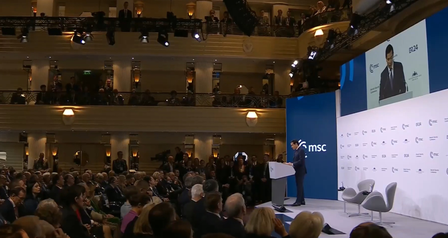
Washington: US Secretary of State Marco Rubio used his first major address at the Munich Security Conference Saturday to call for what he described as a renewed transatlantic mission — one rooted in “seriousness and reciprocity” and focused on reindustrialisation, border control, and emerging technologies such as “cutting-edge artificial intelligence.”
“We gather here today as members of a historic alliance, an alliance that saved and changed the world,” Rubio said in Munich, invoking the Cold War origins of the conference and the “line between communism and freedom” that once ran through Germany.
Rubio argued that the post-Cold War period produced “a dangerous delusion” — including the belief in “the end of history,” that “trade and by commerce alone would now replace nationhood,” and that a “rules-based global order” would “replace the national interest.” He called that “a foolish idea” and said it had “cost us dearly,” pointing to deindustrialisation and weakened supply chains across the West.
“We made these mistakes together, and now, together, we owe it to our people to face those facts and to move forward, to rebuild,” Rubio said.
He framed the Trump administration’s approach as national renewal, telling European allies that while Washington is “prepared, if necessary, to do this alone,” it “hopes to do this together with you, our friends here in Europe.” Rubio described the US-Europe relationship as civilizational, saying, “We are part of one civilisation – Western civilisation.”
Rubio said national security is “not merely series of technical questions,” but begins with “what exactly are we defending,” adding: “Armies fight for a people; armies fight for a nation. Armies fight for a way of life.”
He said “mass migration” is “a crisis which is transforming and destabilising societies all across the West,” and argued, “We must also gain control of our national borders. Controlling who and how many people enter our countries, this is not an expression of xenophobia,” he said.
Rubio urged a broader agenda beyond defence spending — “commercial space travel and cutting-edge artificial intelligence,” “industrial automation,” “a Western supply chain for critical minerals,” and “a unified effort to compete for market share in the economies of the Global South.”
In a brief Q&A, Rubio said the prospects for ending the war in Ukraine remain uncertain. “We don’t know the Russians are serious about ending the war; they say they are,” he said, adding that the hardest questions remain unresolved and “work remains to be done.”
He said, “The United States has imposed additional sanctions on Russia’s oil,” and added, “In our conversations with India, we’ve gotten their commitment to stop buying additional Russian oil.”
Asked about China ahead of a summit expected “in about two months’ time” between President Trump and President Xi Jinping, Rubio said it would be “geopolitical malpractice to not be in conversations with China,” but warned that “nothing that we agree to could come at the expense of our national interest.”
The Munich Security Conference is an annual gathering of global leaders, diplomats, and defence officials that has long served as a key forum for transatlantic security debates, including NATO burden-sharing and major global conflicts.