
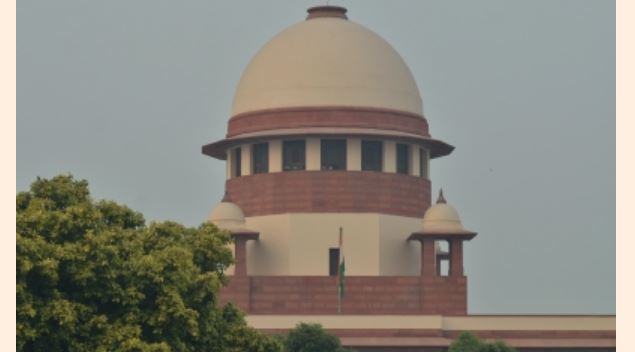
New Delhi: In a significant verdict, the Supreme Court Tuesday took serious note of a large number of vehicles plying without third-party insurance cover and directed the Centre to evolve a pilot project by which fuel for vehicles can be refused at petrol pumps until valid insurance is obtained.
The top court took note of the number of road accidents on national highways and also the effect of long queues at toll plazas, and directed the Centre to implement pilot projects on certain corridors, substituting the process of stopping at toll plazas with automatic detection of vehicles passing through toll points.
A bench of Justices Sanjay Karol and Prashant Kumar Mishra, which flagged the lack of compliance of provisions of the Motor Vehicles Act requiring all vehicles to have a valid insurance policy covering third parties, said it is shocking to learn that nearly 56 per cent of vehicles plying on Indian roads remain uninsured according to the Report of the Standing Committee on Finance 2024-25.
“As deliberated upon in court, the IRDA (Insurance Regulatory and Development Authority) in consultation with the MoRTH (Ministry of Road Transport and Highways) to deliberate and evolve a pilot project whereby fuel for vehicles to be linked with valid insurance status. In the absence thereof, the vehicle concerned would be refused fuel at petrol pumps, until such time that valid insurance is obtained,” the bench said.
It said that the move of denial of fuel will have a two-fold benefit and will assist in identification of uninsured or unregistered vehicles and, secondly, it will prompt the owners of these vehicles to ensure that they have valid insurance status.
“Such projects would ensure ground-level compliance with the statutory mandate of Section 146 of the MVA. This may be done through the use of ANPR (Automatic Number Plate Recognition) cameras,” it said, adding that the Ministry of Petroleum and Natural Gas has, in principle, no objection to the same.
The top court noted that in 2018, the court mandated purchase of third-party insurance for three years for new cars and five years for two-wheelers, at the time of purchase or registration of new vehicles.
“We notice that despite eight years having passed from the said direction, a large number of vehicles remain uninsured. While the IRDA and GIC (General Insurance Council) have recommended that this period not be enhanced, we are of the view that it is in the interest of road safety that the period be enhanced by one year,” it observed.
The bench said, “Therefore, it is directed that henceforth, third-party insurance for four years for new cars and six years for new two-wheelers be required to be purchased. IRDA to immediately issue necessary directions.”
It said in absolute terms, the stark figure of uninsured vehicles stands at 16.54 crore vehicles out of 30.48 crore vehicles, and the consequent effect is that the statutory safeguard of victim compensation is often delayed, if not defeated.
“The object behind mandatory insurance under Section 146 of the MVA is not just that victims of road accidents are compensated, it is also that they are not drawn into prolonged litigation,” it said, adding that the result of vehicles remaining uninsured is that the victims of the accident and their families have no recourse to adequate compensation within a reasonable time period.
The top court noted they often have to enter into prolonged litigation concerning the quantum as well as liability for compensation, and the consequence is even more severe for families where the victim is deceased or has suffered permanent disability, as the financial impact on the family is significantly heightened.
The bench said that in the interest of justice, it directed the insurance regulator IRDA and the MoRTH to deploy ANPR cameras in certain states integrated with data from the Insurance Information Bureau (established under IRDA) and the VAHAN portal for issuance of automatic e-challans to uninsured vehicles.
It said that as on date, there is no uniform mechanism in place with the state police to verify insurance status on the ground and directed that they be provided with handheld devices or downloadable apps, linked with the data from the Insurance Information Bureau (established under IRDA) and the VAHAN portal, be supplied to the state police.
“This is to monitor real-time insurance status of vehicles and impose challans for violations, ensuring compliance with mandatory insurance on the ground,” the top court said, adding that strict compliance of statutory requirements be ensured.
It directed the IRDA to give various policy options including add-on, personal accident cover and own damage cover to private vehicle owners besides a base policy with a minimum cover as required under the Motor Vehicles Act.
The top court passed a slew of directions in a motor accident claim case as it highlighted that it is an unfortunate reality of road safety in India that despite the existence of a statutory framework mandating third-party motor vehicle insurance, the compliance was found to be lacking.
It said that consequently, victims or families affected by motor accidents often have to run from pillar to post to receive compensation.
Orissa POST – Odisha’s No.1 English Daily