
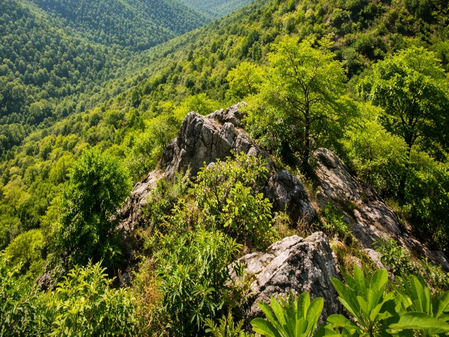
New Delhi: Supreme Court has constituted a high-powered committee to conduct an independent review of the Centre’s report on the definition and delineation of the Aravalli hill range and directed the panel to address what it described as “critical ambiguities” in the findings.
The committee headed by Kanchan Devi, Director General of the Indian Council of Forestry Research and Education (ICFRE) has been directed to submit a comprehensive report by August 31, 2026.
The move comes months after the apex court, on December 29, stayed the implementation of an October 2025 report prepared by a committee chaired by the Secretary of the Ministry of Environment, Forest and Climate Change (MoEFCC).
The court had then emphasised the need for an independent body of domain experts to undertake a fresh scientific and ecological assessment.
In its order, the court observed that a “fair, impartial and independent expert opinion” was necessary after consulting all relevant stakeholders to provide definitive guidance on several contentious issues relating to the protection of the Aravalli ecosystem.
The newly constituted high-powered committee (HPC) will be chaired ex-officio by Kanchan Devi, a 1991-batch Indian Forest Service officer, an autonomous institution functioning under the environment ministry.
The committee’s members include Dr Subhash Ashutosh, former Director General of the Forest Survey of India; Dr Rajendra Kumar Sharma, former Director of the Geological Survey of India; Brij Mohan Singh Rathore, former Joint Secretary in the Environment Ministry; and Prof Ashok K Bhatnagar, former Head of the Department of Botany at Delhi University.
The court also appointed Professor Jagdish Krishnaswamy of the Indian Institute for Human Settlements, Bengaluru, and Prof Laxmikant Sharma of the Central University of Haryana as special invitees who may be associated with the committee’s work by the chairperson as required.
The Ministry of Environment, Forest and Climate Change has been directed to nominate an officer of the rank of Director to serve as the committee’s Member Secretary.
The HPC has been tasked with examining several key questions arising from the October 2025 report.
Among them is whether limiting the definition of the Aravalli range to areas located within 500 metres between two or more hills substantially narrows the extent of protected territory and could facilitate continued mining and other environmentally disruptive activities.
The committee will also examine whether Aravalli hills with elevations of 100 metres and above constitute a continuous ecological formation even when separated by distances greater than the proposed 500-metre threshold, and whether mining activities should be permitted in such intervening gaps.
Another issue flagged by the court concerns the report’s assertion that only 1,048 of Rajasthan’s 12,081 hills satisfy the 100-metre elevation criterion.
The HPC has been asked to determine whether this assessment is scientifically and factually accurate and whether it would leave a large number of lower-elevation hill formations without environmental protection.
The panel will further evaluate whether existing regulatory mechanisms contain significant gaps that warrant an exhaustive scientific and geological investigation of the Aravalli system.
The constitution of the HPC follows consultations among parties before the court.
During the last hearing on May 25, the Centre informed the bench that four experts whose names appeared in the recommendations submitted by both the amicus curiae and the Central Empowered Committee (CEC) could be included in the proposed panel, with the DG of ICFRE serving as chairperson.
PTI