
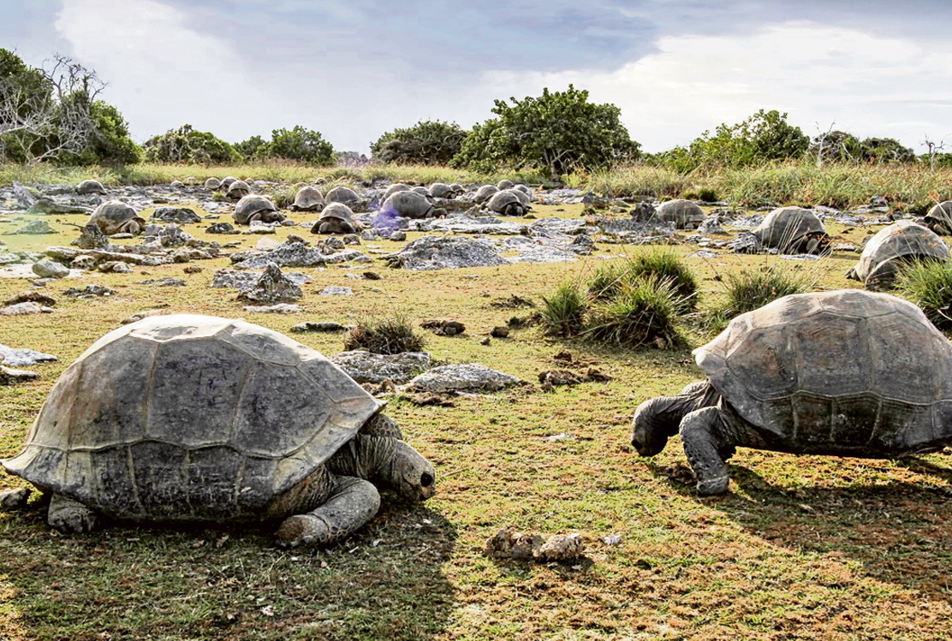
A recent survey revealed that the world’s largest free-roaming population of giant tortoises is thriving on Aldabra Atoll in Seychelles.
According to researchers, approximately 1,80,000 Aldabra giant tortoises now inhabit the island, marking the highest population ever recorded for the species. The study was conducted by the Seychelles Islands Foundation (SIF) in collaboration with the University of Exeter. Researchers analysed five years of tortoise counts collected between 2018 and 2022.
Published in the scientific journal Ecology and Evolution, the study estimated that nearly 183,000 adult and sub-adult tortoises lived on the atoll. It is the first major population update since the late 1990s, when their numbers were estimated at around 100,000. Aldabra Atoll is one of only two places in the world where giant tortoises live freely in the wild.
The other is the Galápagos Islands, which support a much smaller population. The findings highlight the success of decades of conservation efforts. During the 19th century, excessive exploitation reduced the Aldabra giant tortoise population to fewer than 1,000. Protection measures eventually led to the atoll becoming a strict nature reserve in 1981 and a UNESCO World Heritage Site in 1982.
Dr Frauke Fleischer-Dogley, chief executive of SIF, described the discovery as evidence of what long-term conservation can achieve. She said the growing population was encouraging news for Seychelles and the international conservation community. Researchers noted that the population remained relatively stable throughout the five-year survey period.
However, accurately counting the tortoises was challenging because the atoll’s dense vegetation made many animals difficult to observe. Dr Nancy Bunbury, a co-author of the study, explained that researchers used statistical modelling to account for tortoises they could not see.
This approach produced the most reliable population estimate to date and established an important baseline for monitoring future changes. Despite the encouraging results, scientists warn that the species continues to face significant threats. Climate change is expected to bring longer and more frequent droughts, reducing the food and shade available to tortoises.
Rising sea levels also pose a danger to the atoll’s low-lying areas. Invasive animals, particularly feral cats and black rats, present another challenge because they prey on tortoise eggs and hatchlings. Researchers believe that eradicating these invasive mammals could further support population growth and improve the species’ ability to withstand environmental pressures.
Dr Dave Hudson, a postdoctoral research associate at the University of Exeter’s Cornwall campus, welcomed the findings but stressed that the figures should serve as a starting point rather than a final achievement.