
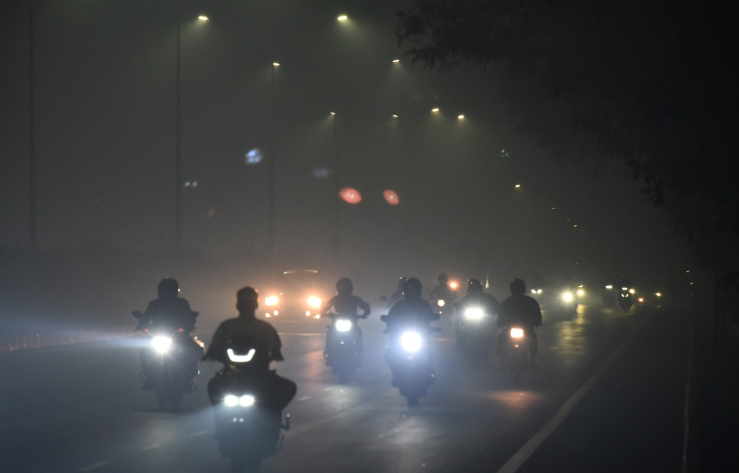
The quality of air that people across cities in India have been breathing on Deepabali nights for the past few years appears to indicate that citizens are kind of determined to make their own lives miserable. Neither citizens nor those entrusted with governing them seem willing to acknowledge the larger environmental crisis of which this is only one aspect.
The use of religious excuses, that celebrating Kali Puja and the festival of lights by bursting firecrackers is completely illogical and makes no sense. History clearly gives a date when gunpowder was first introduced in this sub-continent. Our ancestors had no idea about explosives.
That should be proof enough that what external invaders like Babur brought in as explosives for winning battles has suddenly been accepted by some of us as our ‘age old tradition.’ Surprisingly, Bhubaneswar, which is not usually associated with the kind of chronic air pollution witnessed in Delhi, recorded an extraordinary AQI of 1,091 at 9 pm last night, climbing to 1,254 within half an hour, according to AQI.in.It was the third most polluted city in the country following Chennai (1,280 AQI) and Sri Ganganagar (1,259).
In Bhubaneswar, PM2.5 concentrations touched 622 micrograms per cubic metre, while PM10 levels reached 750 micrograms per cubic metre. Delhi, meanwhile, recorded its most polluted Deepabali in five years, with an average AQI of 376 as per the Central Pollution Control Board. However, several monitoring stations went offline last night during the peak period of firecracker bursting in the national capital. This led the Opposition to accuse the Delhi government of ‘data fraud’and manipulation of air quality readings to understate pollution levels.
In fact, AQI readings put out by private agencies didpaint a much more unpleasant picture than what the official figures reflect, with most parts of Delhi-NCR reporting extremely hazardous air pollution levels, leading experts to cast doubts over government data. For instance, AQI.in reported that Delhi recorded an AQI of 720 at 9 pm on Deepabali.
Some people find it convenient to regard Delhi’s pollution as a consequence of its peculiar circumstances, including vehicular emissions, construction dust and stubble burning in neighbouring states. But Bhubaneswar’s experience exposes the fallacy of treating air pollution as a problem confi ned to a handful of metropolitan cities.
If a relatively less industrialised state capital can experience such hazardous pollution, the environmental threat that bursting of firecrackers poses is far more widespread than we are willing to accept. The failure is as much societal as governmental. Despite restrictions imposed by the administration, firecrackers were burst well before and beyond the permitted one-hour window.
Delhi witnessed a similar disregard for restrictions despite Supreme Court directions on sticking to green crackers. This raises a pertinent question whether celebrations must come at the cost of poisoning the air that everyone, irrespective of religion, class or political affiliation, is forced to breathe.
Governments, too, have reduced environmental protection to an exercise restricted to issuing curbs and announcing emergency measures. The persistence of violations points to weak enforcement, but the larger failure lies in the absence of a sustained public policy that addresses pollution throughout the year.
There is also a tendency to politicise environmental concerns or treat them as inconveniences to economic growth and popular festivities. This is dangerously short-sighted and this is exactly what the right wing in India has been doing for years, especially when sane voices raise their concern over pollution caused by firecrackers.
A recent example is the controversy surrounding actor Dia Mirza’s video message on cracker-free Deepabali. The Brihanmumbai Municipal Corporation (BMC) took down Mirza’s video appealing to people to celebrate without firecrackers and reduce air and noise pollution following objections from BJP leaders.
Mumbai BJP president Ameet Satam criticised her participation, while Mayor Ritu Tawde reportedly questioned her credentials and accused her of being anti-Hindoo. The Bombay High Court subsequently expressed displeasure over the controversy, emphasising that environmental protection should not be viewed through religious or caste considerations and directed the civic body to restore the video.
When the air is polluted, its consequences are borne by everyone — children, elderly people, outdoor workers and those with respiratory and cardiovascular vulnerabilities and even healthy individuals. Sadly, it has become difficult for both the citizens and the government to understand this simple truth.