
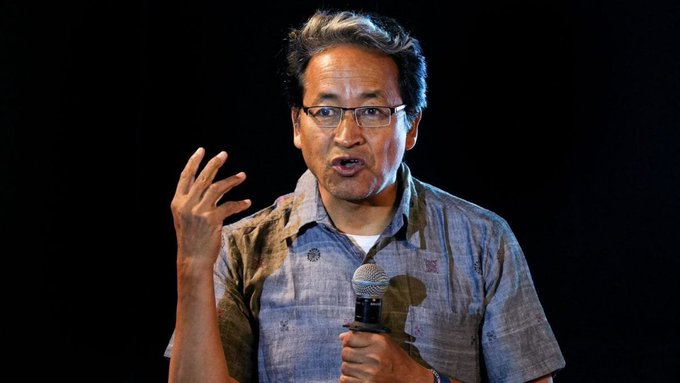
New Delhi: The Centre Monday informed the Supreme Court that climate activist Sonam Wangchuk was in a “perfectly good” condition and was getting the best of the treatment from AIIMS, Jodhpur while in custody.
A bench of Justices Aravind Kumar and P B Varale was informed by Additional Solicitor General K M Nataraj, appearing for the Centre, that no progress has been made as of now regarding the review of Wangchuk’s detention.
At the outset, Justice Kumar asked Nataraj whether any progress had been made at the court’s request to review Wangchuk’s detention in view of his deteriorating health.
“What happened? Any progress? Has it been done?” Justice Kumar asked Nataraj.
The ASG replied, “I will submit… Nothing has been done as of now. He is getting the best of treatment.”
A counsel for Wangchuk submitted that it was high time to reconsider his detention as he continued to be unwell.
Justice Varale said that was what the court said on the last occasion when it made the suggestion.
“There are issues, and it’s not like you are not denying it, and he is also making a complaint of health issues. The doctor says yes, it is there, and now treatment is being provided. Admittedly, the health issue is there, and on the last day itself we made the suggestion,” Justice Varale told Nataraj.
ASG Nataraj submitted, “So far, the health issue is concerned, he is perfectly good Jaipur is a better place to get treatment than Ladakh. There is AIIMS in Rajasthan, whereas in Ladakh, there would have been nothing.”
Justice Varale said, “No, no, you can’t say that.”
Nataraj urged the bench to take up the matter after tomorrow.
The bench told the ASG, “This is a habeas corpus petition. ASG Nataraj, you should understand that in a habeas corpus petition, you can’t say that. On (last) Friday also, we could not take up the matter.”
However, the bench agreed to take up Wednesday the plea of a habeas corpus petition filed by Wangchuk’s wife Gitanjali Angmo seeking to declare his detention under the National Security Act (NSA), 1980, as illegal.
It clarified that no further adjournments will be granted.
Earlier, appearing for Angmo, senior advocate Kapil Sibal moved an application seeking that a specialist doctor examine Wangchuk, as he had frequently complained of stomachache, possibly due to contaminated water.
Wangchuk was examined by doctors at AIIMS Jodhpur following the court’s order and a report was submitted to the court.
On February 4, the top court asked the Centre if there was any possibility for the government to relook at Wangchuk’s detention considering his health condition.
The court observed that Wangchuk’s health report was not good and asked ASG Nataraj to seek instructions in the matter.
Nataraj said that he would put the suggestion to the concerned authorities.
Last week, the Centre and the Ladakh administration told the apex court that Wangchuk was detained for instigating people in a border area where regional sensitivity is involved.
Justifying Wangchuk’s detention, Solicitor General Tushar Mehta told the bench that all procedural safeguards were followed while ordering his detention under the NSA.
Earlier, the Centre said that Wangchuk tried to instigate Gen Z for protests like in Nepal and Bangladesh.
Mehta said that Wangchuk even referred to Arab Spring-like agitation which has led to the overthrow of multiple governments in countries of the Arab world.
The NSA empowers the Centre and states to detain individuals to prevent them from acting in a manner “prejudicial to the defence of India”. The maximum detention period is 12 months, though it can be revoked earlier.
On January 29, Wangchuk, who is under detention in the Jodhpur Central Jail, denied allegations that he made a statement to overthrow the government like the Arab Spring, emphasising that he has the democratic right to criticise and protest.
Wangchuk was detained September 26 last year, two days after violent protests demanding statehood and Sixth Schedule status for Ladakh left four people dead in the Union Territory (UT). The government accused him of inciting the violence.
The plea said it is wholly “preposterous” that Wangchuk would suddenly be targeted after more than three decades of being recognised at the state, national and international levels for his contributions to grassroots education, innovation and environmental conservation in Ladakh and across India.
Angmo said the unfortunate events of violence in Leh September 24 last year cannot be attributed to the actions or statements of Wangchuk in any manner.
Wangchuk himself condemned the violence through his social media handles and categorically said violence would lead to the failure of Ladakh’s “tapasya” and peaceful pursuit of five years, Angmo said, adding it was the saddest day of his life.