
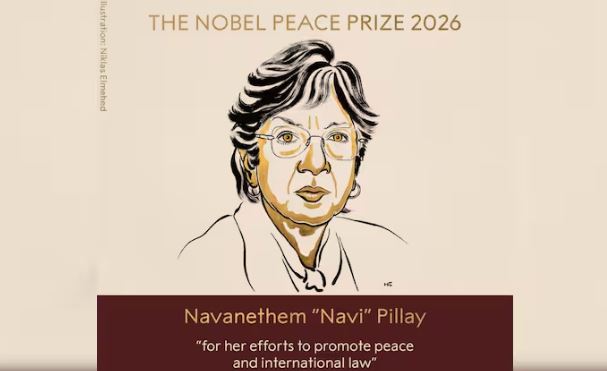
Oslo: South African jurist of Indian origin Navanethem “Navi” Pillay, a former UN human rights chief whose work helped shape international law on genocide and sexual violence, won the 2026 Nobel Peace Prize Friday for her efforts to promote peace and international law.
She is also serving as a judge in a case at the International Court of Justice in which The Gambia has accused Myanmar of violating the Genocide Convention.
Born in Durban September 23, 1941, to Indian parents of Tamil descent, Pillay grew up under apartheid and went on to build a career challenging racial discrimination, defending anti-apartheid activists and advancing human rights and equality.
In September 2025, the Independent International Commission of Inquiry on the Occupied Palestinian Territory, including East Jerusalem, and Israel, chaired by Pillay, concluded that Israeli authorities and security forces had committed and were continuing to commit genocide against Palestinians in Gaza.
The commission found that four of the five acts listed under the Genocide Convention had been committed and concluded that they were accompanied by the specific intent required to establish genocide. It also concluded that Israeli President Isaac Herzog, Prime Minister Benjamin Netanyahu and then Defence Minister Yoav Gallant had incited genocide. Israel rejected the report’s findings.
Also Read : Nobel to honour Navi Pillay: How Nuremberg trial transcripts shaped Indian-origin jurist’s pursuit of justice
The commission called on Israel to immediately end the genocide and investigate and punish those responsible. It urged all UN member states to use all means reasonably available to prevent genocide and cease transfers to Israel or third states of arms, equipment or other items, including jet fuel, where there was reason to suspect their use in military operations that had involved or could involve genocide.
It also urged states to ensure that individuals and corporations under their jurisdiction were not involved in genocide or incitement to genocide, and to investigate and prosecute those implicated.
The commission further recommended that states facilitate investigations and domestic proceedings and take action, including possible sanctions, against Israel and individuals or corporations involved in or facilitating genocide or incitement to genocide.
The commission was established by the UN Human Rights Council. Its findings were those of an investigative body, not a final ruling by an international court.
According to a biographical profile published by the Institute for African Women in Law, Pillay’s father was a bus driver who worked multiple jobs to support the family, while her mother looked after their eight children. Despite financial hardship, her parents placed a strong emphasis on education and insisted that their daughters, like their sons, should be educated.
Pillay studied at the University of Natal and later earned postgraduate law degrees from Harvard University.
In 1967, she became the first woman of colour to establish a law practice in South Africa’s Natal Province, according to the Institute for African Women in Law.
She spent decades defending anti-apartheid activists and highlighting the treatment of political detainees.
In 1973, she helped secure the right of political prisoners to access legal counsel, according to South African History Online.
She also represented anti-apartheid activists and drew attention to the use of torture and solitary confinement against detainees.
Pillay was involved in efforts to enshrine equality in South Africa’s Constitution. As a member of the Women’s National Coalition, she contributed to the campaign that helped secure a constitutional equality clause prohibiting discrimination.
In an interview with South African History Online, she described how women from different political, racial and religious backgrounds worked together to advance equality and protect women’s rights.
Her career later took her to South Africa’s High Court, the International Criminal Tribunal for Rwanda and the International Criminal Court. She served as a judge and president of the Rwanda tribunal and as the UN High Commissioner for Human Rights from 2008 to 2014.
During a visit to Sri Lanka in August 2013, Pillay warned that the country appeared to be becoming increasingly authoritarian and that the rule of law was being eroded four years after the end of its civil war.
She said people who had met her during the visit had faced harassment and intimidation and raised concerns about attacks on religious minorities. In the northern city of Jaffna, she met Tamil families who spoke of missing relatives, military acquisition of land and inadequate basic facilities. Pillay said she would continue to focus on the treatment of people she had met.
The Sri Lankan government rejected allegations of intimidation and said she had been allowed to meet anyone she wished.
One of the most consequential chapters of her judicial career was her work at the International Criminal Tribunal for Rwanda, where she was one of the judges in the landmark case against Jean-Paul Akayesu, a former mayor convicted of genocide, crimes against humanity and direct and public incitement to commit genocide during the 1994 Rwandan genocide.
The tribunal’s 1998 judgment established that rape and sexual violence could constitute acts of genocide when committed with the requisite intent, as well as crimes against humanity.
The Norwegian Nobel Committee credited Pillay with playing a significant role in this legal development.
The committee also highlighted the tribunal’s work on incitement to genocide. In the Akayesu case, the tribunal convicted the defendant of direct and public incitement to commit genocide, establishing an important precedent in international criminal law.
Pillay also co-founded Equality Now in 1992 alongside Jessica Neuwirth and Feryal Gharahi, according to the organisation’s official history. The international women’s rights organisation works to advance women’s rights and challenge discriminatory laws and practices.
Announcing the Nobel award, the Norwegian Nobel Committee praised Pillay’s commitment to universal legal principles and said she had held states and national leaders accountable while bringing hope to victims of violence and conflict.
It described her as one of the most respected international jurists of her time and stressed that the rule of law was essential to maintaining peace and resolving conflicts without violence.
“Peace requires justice,” the committee said, arguing that lasting peace must rest on legal principles rather than the will of powerful states or a fragile balance of power.
“At a time of existential challenges – including more wars and conflicts than the world has seen in a long time international law is no longer just a supplement to peace and security. It is an absolute necessity,” it said.
The Nobel Peace Prize was first awarded in 1901, making 2026 its 125th anniversary.
European Commission President Ursula von der Leyen congratulated 85-year-old Pillay on winning the Nobel Peace Prize, praising her lifelong commitment to justice, peace and human dignity.
“Few have devoted their lives to justice, peace and human dignity like she did,” she said in a post on X. “From the violence of apartheid in South Africa to the horrors of the Rwandan genocide, she has confronted some of humanity’s darkest chapters. She has looked the brutality of injustice in the eye and never looked away.”
“She is the defender of the persecuted, the vulnerable, the voiceless and the excluded. Of the rule of law over the right of might. In a world that needs justice more than ever, her courage and moral clarity are a precious compass,” she added.