
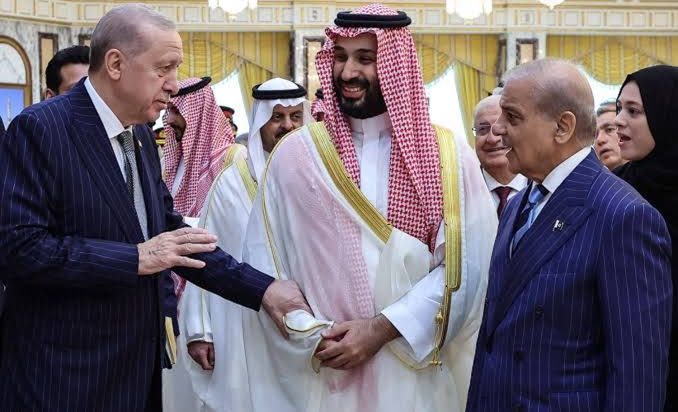
The defence pact between Saudi Arabia, Turkey and Pakistan, signed in Mecca on the principle that an attack on one would be treated as an attack on all, is more than a new security arrangement in West Asia. For India, it is a direct threat and represents a potentially significant shift in the international strategic balance stretching from the Mediterranean through the Persian Gulf to the Arabian Sea. By bringing together Saudi Arabia’s financial and energy might, Turkey’s growing defence-industrial capabilities and Pakistan’s nuclear military manpower strength, the pact could give Islamabad a new regional platform at a time when New Delhi is already confronting an increasingly complex security environment all along its borders.
The agreement is rooted in the growing uncertainty surrounding the existing American-led security set up in the Middle East. The prolonged conflict in the region, Iranian missile and drone capabilities, and threats to shipping and instability around the Strait of Hormuz have demonstrated that even overwhelming American military power cannot guarantee complete security for its regional partners. Saudi Arabia, which has itself faced Houthi and Iranian missile and drone attacks, appears increasingly interested in developing alternative security partnerships rather than relying exclusively on Washington.
For India, however, the most consequential aspect of the pact is Pakistan’s elevation as a security partner of two major regional powers. Pakistan has struggled for years with economic weakness and declining strategic influence but its diplomatic capabilities have always excelled. The Mecca agreement potentially alters while proving that equation. Islamabad now has an opportunity to present itself not merely as a South Asian military power but as an important component of an emerging West Asian security architecture. A formal security relationship with Saudi Arabia and Turkey could provide Pakistan with greater diplomatic legitimacy, financial support and access to advanced defence technologies while it can itself offer nuclear cover for the others.
This is where India’s concerns become particularly serious. Turkey has already emerged as an increasingly important drone and defence equipment partner for Pakistan. Ankara has supplied Pakistan with armed drones, precision-guided weapons, naval platforms and other advanced military technologies which have been used against India already. These weapons were evident during last year’s four-day military confrontation between India and Pakistan. If Saudi financial resources are increasingly channelled into Turkish-Pakistani defence projects, the pace of Pakistan’s military modernisation could accelerate.
Such developments cannot be viewed in isolation by New Delhi. India’s western front is already complicated by Pakistan’s conventional military capabilities, its nuclear arsenal and the continuing possibility of conflict along the Line of Control and international border. Now that substantial improvement in Pakistan’s access to sophisticated drones, electronic warfare systems, naval platforms, precision weapons and surveillance technologies are a distinct possibility, it will alter the conventional balance.
New Delhi has cultivated close economic ties with Riyadh and has little reason to jeopardise them but the desertion of Chabahar port responsibilities has given out a regional message that India cannot be counted upon in essential heavy projects. Millions of Indians also work across the Gulf, making the stability of India-Saudi relations economically indispensable for India.
New Delhi cannot afford to be complacent. Pakistan is certain to use its new strategic position to obtain greater diplomatic backing from Riyadh and Ankara during future crises with India. Even if Saudi Arabia remains neutral, which is highly unlikely, Pakistan’s association with two influential regional powers could give Islamabad additional diplomatic space and bargaining power. The possibility that a bilateral India-Pakistan crisis could acquire wider West Asian dimensions is therefore something Indian policymakers must take seriously.
The pact also has a direct bearing on India’s energy security. The Gulf remains vital to India’s economy. Any military escalation involving Iran, Saudi Arabia or other regional powers could threaten the Strait of Hormuz, through which a substantial portion of India’s imported crude and other energy supplies pass. A prolonged disruption aimed at India could push up oil prices and increase India’s import bill, put pressure on the rupee and complicate the government’s battle against inflation and poverty. All these things are already happening now in a different form in the wake of the current US-Israel war on Iran.
The threat extends beyond oil. India’s trade with Europe, Africa and West Asia depends upon secure maritime routes through the Arabian Sea, the Gulf of Aden and the Bab-el-Mandeb. Any restructuring of military deployments in the Gulf and the Arabian Sea could therefore have consequences for Indian commercial shipping.
This makes maritime security the second major Indian concern. If Pakistan expands its naval and air presence in Saudi Arabia or other Gulf locations under the new treaty framework, India’s western maritime neighbourhood could become more strategically contested. New Delhi will now have the additional burden to ensure that Indian merchant vessels, energy tankers and naval assets retain unrestricted freedom of navigation across the Arabian Sea and the wider western Indian Ocean.
India’s response, therefore, cannot simply be diplomatic protest or passive observation. It requires stronger leadership that is capable of encouraging maritime surveillance, greater naval preparedness and deeper cooperation with countries that share an interest in keeping the Indian Ocean open and secure.
The pact also demonstrates why India’s policy of strategic autonomy remains essential. New Delhi cannot afford to choose sides in an increasingly fragmented Middle East. It has important relationships with Saudi Arabia, the United Arab Emirates, Iran, Israel, and the United States, even though these relationships vary significantly in intensity and political character. India needs all of them for different reasons such as energy, trade, investment, connectivity, defence, technology and the welfare of its diaspora. Interestingly, none of them need India in equally desperate measure.
For India, the Mecca pact should therefore be read as an early warning. The Middle East is no longer moving within a security framework dominated by a single external power. Regional states are increasingly building their own combinations of military, economic and diplomatic power. Pakistan’s participation gives the development a direct South Asian dimension. Beyond this, the Mecca pact may not remain a mere Middle Eastern copy of NATO. But for India, it is significant precisely because it connects developments in West Asia with the security of India’s own western frontier and more importantly, India’s energy supply. New Delhi can no longer view the Gulf, Pakistan and the western Indian Ocean as separate strategic theatres. They are becoming parts of the same geopolitical equation, and India has a long way to prepare for the future accordingly.