
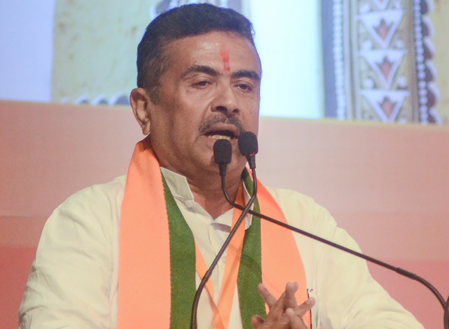
Kolkata: In a watershed moment in West Bengal politics, Suvendu Adhikari is set to take oath as the state’s first BJP chief minister Saturday at the Brigade Parade Ground, a vast green expanse in the heart of Kolkata that has been prepped up for the saffron coronation.
Opening a new chapter in Bengal politics, the BJP marched to power in the state for the first time with 207 seats in the 294-member Assembly, ending the 15-year rule of the TMC, which was reduced to just 80.
The swearing-in ceremony at the Brigade Parade Ground — a venue steeped in the state’s political symbolism and long associated with massive Left and opposition mobilisations — is expected to be attended by Prime Minister Narendra Modi, Union Home Minister Amit Shah, chief ministers of NDA-ruled states, senior BJP leaders and thousands of party workers from across the state.
Along with Adhikari, several newly elected party MLAs are likely to take oath as members of the first BJP council of ministers in Bengal, party leaders said.
While the final list was yet to be officially announced, leaders from north Bengal, Junglemahal, Matua-dominated belts and tribal regions are also expected to find representation in the ministry as the BJP looks to balance regional, caste and community equations in its maiden Bengal government.
For the BJP, the oath-taking ceremony is far more than a constitutional formality. The party is seeking to project it as the culmination of a decade-long political expansion in Bengal, a state that had for decades remained among the toughest frontiers for the saffron camp despite its sweeping dominance elsewhere in the country.
The venue holds massive political significance. The ground, which once served as the citadel of the Left’s show of strength and later became a battleground for anti-Left and anti-BJP mobilisations, will for the first time host the swearing-in of a saffron government in Bengal.
Party leaders said the BJP intends to use the event to signal not merely a transfer of power but what it describes as the beginning of a new political era in the state after years of bitter and often violent political polarisation.
For Adhikari, Saturday’s ceremony marks the culmination of a dramatic political journey that saw him evolve from a grassroots Congress activist to one of the most influential leaders of the Trinamool Congress before eventually emerging as Mamata Banerjee’s principal challenger.
Once regarded as one of Banerjee’s closest aides and a key architect of the TMC’s rise in rural Bengal, Adhikari crossed over to the BJP in 2020 amid deepening differences and rapidly became the saffron camp’s most recognisable face in the state.
His victory over Banerjee in Nandigram in the 2021 assembly polls had already elevated him into a central figure in Bengal politics.
The BJP’s emphatic victory this time has now placed Adhikari at the centre of the party’s attempt to reshape the state’s political landscape.
Adhikari, who hails from Purba Medinipur district, will also become Bengal’s first chief minister in over five decades to come from the districts rather than Kolkata’s traditional political establishment.
The last chief minister from Bengal’s rural hinterland was Ajoy Mukherjee in 1970. Incidentally, Mukherjee too hailed from the undivided Medinipur region, long considered one of Bengal’s most politically influential belts.
Security arrangements across Kolkata have been tightened ahead of the ceremony, with thousands of police personnel deployed around Brigade Parade Ground and key arterial roads in the city.
Senior BJP leaders said representatives from several religious and social organisations, industrialists, cultural personalities and party workers from all districts have been invited to the event.
The ceremony is likely to be followed by Adhikari’s first cabinet meeting, where the new government may outline its initial administrative priorities and review implementation of some of the BJP’s major electoral promises.