
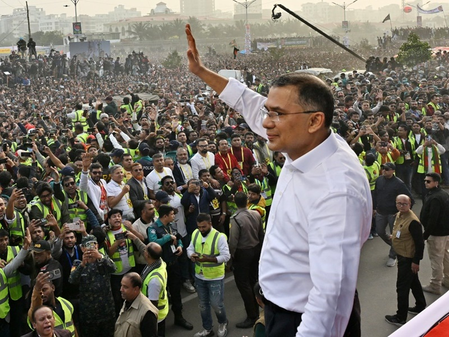
The people of Bangladesh have spoken decisively that they still believe in democracy and would not be swayed by polarising politics or chaotic movements for supposedly righting wrongs by an earlier regime. Nearly 60 per cent of the country’s population took part in the election. The sole blemish in this democratic process was the denial of electoral participation to the Awami League that had ruled the country for 15 years at a stretch. For this, of course, the party itself and its leadership may have to blame for allegedly trying to be autocratic and indulging in unbridled corruption. This seems to have infuriated the people to such an extent that they forced then Prime Minister Sheikh Hasina to flee the country with what came to be known as the ‘Monsoon Revolution’ of 2024.
The people’s mandate is clear with the Bangladesh Nationalist Party (BNP) and allies bagging 212 seats against the tally of 77 seats secured by the rival 11-party alliance, led by the Islamist party Jamaat-e-Islami. The National Citizen Party (NCP), led by youth activists instrumental in toppling Hasina and part of a Jamaat-led alliance, came a distant third, winning merely six seats of the 30 seats that it contested. Shortly before the overthrow of Hasina, the fundamentalist forces, with the help of the youth groups protesting against Hasina’s government, ruled the roost. Those protests pushed the country into chaos and mindless violence against the minority population. At one stage during the interregnum under a caretaker government, it was feared that the country would be controlled by pro-Pakistani fundamentalist forces. Such a prospect appeared to be likely as the Jamaat-e-Islami closed ranks with the BNP in the regime change.
Significantly, a referendum on constitutional reforms was also held along with the election, and the election commission said about 48 million voters chose “Yes,” while about 23 million said “No.” The changes include two-term limits for prime ministers and stronger judicial independence and women’s representation, while providing for neutral interim governments during election periods and setting up a second house of the 300-seat parliament. These are changes that even a country like India should ponder introducing in its Parliamentary process.
A difficult task lies ahead for the new BNP government, which has promised a new era of democracy and zero tolerance towards corruption. It has to rebuild institutions, create opportunities for young people and keep constantly proving that this government is accountable to its citizens.
Despite the BNP securing a two-thirds majority, the resurgence of the Jamaat e-Islami and its Islamist alliance – parties that were banned under Hasina – could present major challenges for the BNP and Bangladesh’s secularism in the future. The Jamaat and its allies, who follow even harder-line Islamist politics, believe in the introduction of Sharia law. The number of seats that the alliance has won is the highest in its history, and it forms a formidable op position. The Jamaat’s leadership is already accused of regressive policies and controversial views on women’s rights in the home and at the workplace. Human rights groups have also raised an alarm over a recent surge in moral policing of women, with incidents such as girls being prevented from playing football and the enforcement of modest dress and headscarves. The alliance hoped to get more seats and be in the driver’s seat for running the government. That calculation has gone awry, and the leadership is unable to conceal its frustration.
It has pointed out that though the election was fair and peaceful, there were manipulations during the counting of votes in many seats. It has announced to play a constructive role as an Opposition, but warned that it would not accept quietly if the people’s aspirations are not fulfilled by the new government. This is a veiled threat to the BNP, which has made it clear that it will not kowtow before Pakistan, China or India and will let the nation’s interests influence its foreign policy.
This could be music to India’s ears as the forces that had toppled Hasina launched a tirade against India, accusing it of interfering with Bangladesh’s internal politics and economy. Prime Minister Narendra Modi did not waste time in congratulating the BNP chief Tarique Rahman, asserting that India will continue to stand in support of a democratic, progressive and inclusive Bangladesh. One of the biggest geopolitical challenges facing the new government of Bangladesh will be rebuilding relations with India. Under Hasina, India was Bangladesh’s closest ally, but ties severely frayed after her government fell and have become outwardly hostile in recent months.
This was considered a major failure of India’s intelligence fraternity that could not guide the government on how to set right the faux pas committed by the foreign policy makers in Delhi. Rahman, on the other hand, has made the right noises about certain “issues” with India and said he would only want “a relationship of mutual respect, mutual understanding.”
Rahman is burdened with the task of building bridges with India, and at the same time, he insists that India should not allow Hasina to use it as a safe haven, along with hundreds of her party members,s many of whom are wanted by the law. He has made a smart move by telling the media that the successful resolution of the matter depends mostly on India.
India too needs to wake up, refashion its geopolitical strategy and use the new opportunity to win back the confidence of the people of Bangladesh so that Pakistan and China cannot get the upper hand. It must never be individuals or specific political parties of any ‘near abroad’ countries that should solely control India’s foreign policies. Indian foreign policy must be robust, transparent and trust worthy enough with neighboring countries. Bangladesh must occupy a special place in Indian policy.
In spite of rising Islamist thoughts, Bangladeshis have kept the Mullahs at bay. India must recognize this characteristic of the Eastern Bengali Moslem, seize the opportunity and reach out to the common people of Bangladesh at very many levels if it desires a safe border in the North East.