
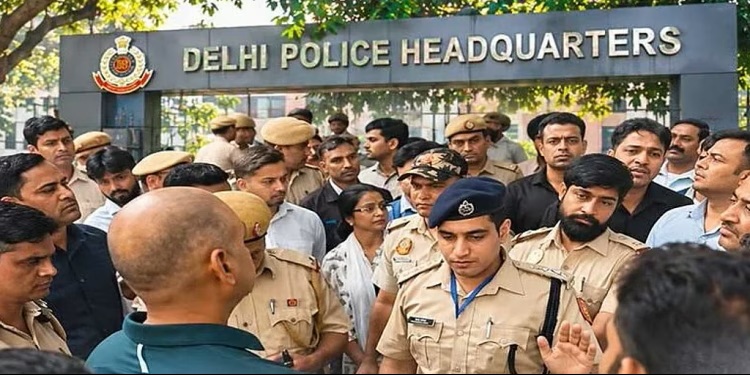
The demonstration by scores of policemen and officers outside the Delhi Police headquarters on 2 November to protest against some actions of the authorities and the subsequent suspension of Assistant Commissioner of Police (ACP) Manasvi Vashishta, who led the protest, for “violation of discipline” has opened up disturbing questions about the people’s democratic right to protest.
Ironically, it is the same police which had ruthlessly suppressed the same right during the recent agitation by students and youths on the streets of Delhi. The ACP joined around 100 police personnel who gathered outside Gate No. 1 of the Delhi Police headquarters demanding a meeting with Police Commissioner Anurag Kumar over the recent fiasco with lawyers at the Shahdara police station. Vashishta and Arun Kumar, the Station House Officer of the Shahdara police station, had earlier been transferred following an indefinite strike called by city lawyers over the handling of an assault case involving an advocate. The protest began around 8 am, with personnel holding placards and posters and demanding a meeting with the CP and reinstatement of the two officials.
After nearly three hours the CP and other senior officers met the protesters and heard their demands that included standard operating procedure (SOP) for handling confrontations involving lawyers, restricting the number of lawyers entering a police station to five at a time and registering FIRs against lawyers allegedly involved in misconduct towards police personnel. They also sought a dedicated cell at police headquarters to address complaints against lawyers, including recommending action against their Bar Council licences and deployment of police personnel in courts to deal with incidents of “violence and misbehaviour.” The transfers followed an altercation with lawyers on 23 October at Shahdara police station in which an advocate allegedly sustained a head injury. District court lawyers subsequently launched an indefinite strike, alleging that ACP Vashishta and SHO Kumar had threatened advocates who went to the police station over the handling of the assault case. They demanded action against the officers.
Vashishta was transferred to the Special Police Unit for Women and Children, while Kumar was moved to the Security Branch. The lawyers called off their strike after the transfer orders were issued. The disciplinary action triggered the protest by the policemen who felt two of their colleagues had been penalised for performing their duty. But their demonstration immediately brought into question Delhi Police’s ruthless suppression of the youth’s democratic right to peaceful protest at the protest site of Jantar Mantar and other parts of the national capital.
The specious plea of not allowing the demonstrations was that they did not have police permission, which is itself a debatable issue. According to one interpretation, the law enforcing agencies are required only to be informed beforehand about demonstrations so that they can make arrangements for people moving along the protest area without being inconvenienced. However, the police and the government have been abusing this British-era provision to arrogate to themselves the power to “permit” or disallow peaceful demonstrations. It has become a practice not to give “permission” to protesters if they seek to criticise government actions and policies, as the British rulers used to do. The country helplessly witnessed, in the past few weeks, how the democratic rights of students and youths to peaceful protest were trampled down by the same Delhi police. Thousands of protesters were detained, girls were roughed up, and many were mercilessly beaten for demanding the resignation of the Chief Election Commissioner (CEC) Gyanesh Kumar for striking off the names of crores of voters from the voter list and depriving millions of youths of their right to vote across the country. The police appeared not to have gone by the rule book in silencing the youths’ voice, but supposedly only acted on orders from the top to stop the protestors exercising their democratic right to protest peacefully against the actions of Constitutional bodies such as the Election Commission and the political party in power at the Center apparently benefiting from the EC’s actions.
Many of the policemen and their female colleagues did not even wear badges on their uniforms during the demonstrations lest they should be identified during their high-handed actions against the protesters on Delhi streets. They also behaved brashly with journalists and severely curtailed their right to cover the events. The arrogance of the Delhi Police acting at the behest of the government ran counter to its role of being public servants. Seen in this perspective, the Delhi police demonstration against the authorities appears to be poetic justice orchestrated to make them look like victims of the judicial system.
More so, when some of the policemen and their female colleagues told the media during their agitation that they had a right to protest peacefully. They did not, however, respect this exact same right of the citizens protesting against manipulations of the democratic system. The truth, however, is the demonstration by the police violate their service conduct rules. That is why the authorities immediately put Vashishta under suspension for violating service rules by apparently instigating his colleagues to demonstrate outside the police headquarters. The police should be expected to act according to the law and not on the whims, caprices and interests of their seniors. This can only lead to further chaos and anarchy, where the police could become the true victim.