
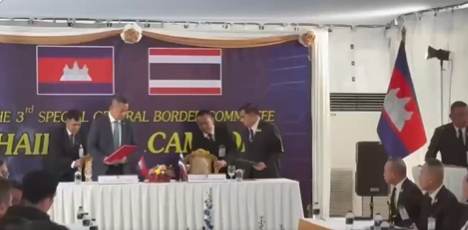
After a protracted, bloody conflict in which over 100 people were killed and about half a million civilians in both countries living in the border areas were displaced, Thailand and Cambodia finally agreed to hold a ceasefire December 29 and expressed a desire to rebuild mutual trust. However, the ceasefire has already suffered initial jolts with the Thai military accusing its Cambodian counterparts of violating the truce with drone flights. Cambodia, of course, downplayed the violation, glossing it over as a minor incident, but Thailand is not convinced by the explanation.
Stretching over 817km, the shared land border between Thailand and Cambodia has been the scene of continual conflicts for more than a century. Sovereignty has been contested since France, which occupied Cambodia until 1953, first mapped the border in 1907. US President Donald Trump had brokered a ceasefire deal in July, but it did not last long, and fighting continued. Bangkok reluctantly agreed to the deal because the US wielded tariffs as leverage. Phnom Penh, in the weaker position, was happier for it to intercede. Thailand then accused Cambodia of laying new landmines in border areas, injuring several Thai soldiers. The conflict reignited in early December with each side blaming the other.
The century-old territorial dispute between Thailand and Cambodia centred around disagreements over colonial-era maps. The two countries had clashed before over an ancient temple and seen unrest over who could claim other aspects of the heritage. Thailand has also attacked the proliferation of criminal online scam centres in Cambodia. But more than the age-old grievances, it is the nationalist feeling and compulsions of domestic politics that provide the trigger for the continuing border tension and skirmishes. In Cambodia, the longstanding ruler Hun Sen has given way to his son Hun Manet in a dynastic dictatorship. This has caused anger in neighbouring Thailand, and the Cambodian leadership lapped it up to whip up nationalistic feelings that helped to legitimise a regime that has little to offer its people.
In Thailand, the long-running feud between the powerful military and royalist elites and the politician Thaksin Shinawatra, his family and proxies has been the most predominant domestic political concern. In August, a court dismissed his daughter, Paetongtarn Shinawatra, as Prime Minister for her failure to protect the country’s interests after a recording of her discussing the border dispute with Hun Sen was leaked. It captured her addressing him as “uncle”, promising to “take care of it,” and denigrating a key military commander. This created a huge backlash against her and played to political opponents’ claims that the Shinawatra family were happy to sell the country’s interests for personal benefit.
The caretaker PM, however, earned popularity by giving the military free rein in its stated aim of crippling the Cambodian army. The clashes are so well timed before the next elections that they help distract the people from governmental woes – including a poor response to deadly floods – as well as positioning the army as national champions.
It appears both sides have agreed to the ceasefire, however fragile it may be, after their respective armies suffered considerable casualties, while the large number of displaced citizens living in the border areas is sowing seeds of further popular discontent. The UN Secretary-General Antonio Guterres called the ceasefire a positive step towards alleviating the suffering of civilians, ending current hostilities and creating an environment conducive to achieving lasting peace.
The Association of Southeast Asian Nations (ASEAN) and China hailed the peace initiative in the interest of regional peace and trade. An observer team from ASEAN will also monitor the ceasefire arrangements. Peace is the need of the hour, and people’s concerns need to be put far above the manipulations of scheming politicians and army top brass, which are the bane of countries in this part of the globe.
Interestingly, India has not cared to utter a word in this regard and made itself a nation without any relevance in its own neighbourhood while it thinks fit to express ‘concern’ on a supposed drone attack on the home of Putin in Moscow. This kind of silent distancing from real issues near home has harmed India’s diplomacy in this part of Asia.