
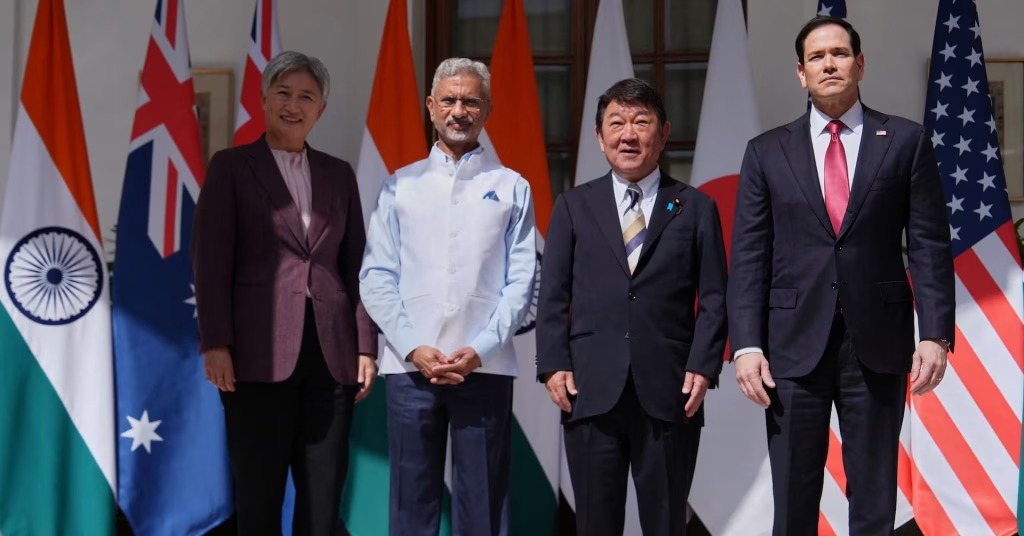
The Quad meeting of the Foreign Ministers of Australia, India, Japan and the United States in New Delhi 26 May shows that the strategic grouping is still breathing even after the US administration under President Donald Trump pulled the oxygen pipe. Ample proof has been given over the past year or more that the US does not attach much importance to such alliances. Coming close on the heels of Trump’s visit to Beijing, the session this time around is dominated by fears of China’s growing strength in the Asia-Pacific region.
As China gathers strength, the Quad is indeed becoming ever more valuable to India alone while other involved nations seem disinterested, including the US. Doubts about the group’s survival have been creeping because the Quad’s national leaders have not met since 2024. In fact, Trump’s lack of interest in the grouping has been cited by experts as tell-tale evidence that the Quad is fading away. It is undoubtedly losing steam. Last year’s planned meeting of Quad leaders was reportedly cancelled due to tension between Washington and New Delhi following Trump’s trade war against India in particular. But for the time being the foreign ministers’ meeting is being put up as a necessity of the time. Continuity of contact and action is required at all levels in the Quad and foreign ministers can facilitate the collaborations but how far these countries can go opposing China is a major question. Significantly, when the Quad appears to be on its deathbed, China proves to be a key factor injecting a new lease of life to it as it was previously perceived to be the common enemy of the four countries. This was the reason for the Quad’s reestablishment in 2017 and its elevation to the level of foreign ministers’ meetings in 2019.
Back then, there was not even a joint statement, yet this did not make the group insignificant. Quad provided a vital mechanism for its members’ foreign policy and security communities to collectively counter the growing maritime threat China poses in the Asia-Pacific region. Alas, all that seems to be coming to an end. Trump’s approach to international affairs hinges on personal relationships and bilateral agreements. He knows that the US, like all major powers, can influence other nations’ policies directly, not necessarily through groups. But the China challenge is most likely too hot for Trump to handle with bilateralism. It makes the US’ alliance network and mini-lateral groups, such as the Quad, much less important for Washington since Trump would rather befriend China’s Xi more than India’s Modi. What is vexing for the US, as was evident in the recent summit between Xi and Trump, is that China is increasingly becoming confident of its diplomatic, strategic and economic strength. It is no mere coincidence that as soon as Trump left Beijing after meeting Xi, Russian President Vladimir Putin landed in the Chinese capital.
Unlike Trump, he came not as a rival but as a partner in a public plan for global authoritarian domination. The Iranian Foreign Minister Abbas Araghchi, had also been in Beijing just before Trump’s summit. Xi reportedly plans to visit North Korea soon. The Quad meeting in New Delhi is being seen as the answer to the tests Beijing is setting for collective action in the form of Quad. While the closure of the Strait of Hormuz dominates discussions of top international groupings, China continues to get top priority. The Quad meeting of Foreign Ministers is one more proof of the Sino-centric geopolitical strategies. That is why US Secretary of State Marco Rubio has been sent to New Delhi by Washington to reassure the allies that the US has not abandoned the Indo-Pacific. For Australia, Japan and India, the task is to continue investing in their national security as the most effective way to ensure the US is confident that they are not taking economic benefits from China while leaving the security burden on the US alone. India and Japan continue to grapple with border and territorial disputes with China. The Chinese navy circumnavigated Australia in the middle of an election campaign last year.
For all Quad nations, Beijing’s objectives of technological supremacy, taking over Taiwan, ruling the South and East China Seas and dominating the Indian Ocean and Pacific island nations represent a threat to security and sovereignty of the whole of Asia. The Foreign Ministers meeting will probably reinforce the ongoing importance of the group. That will, indeed, be some progress, given the fact that Trump is pulling the US out of most important international groupings. At the moment nothing more should be attached to Quad deliberations despite economic exchanges and defence commitments being made. India needs to understand QUAD is dead.