
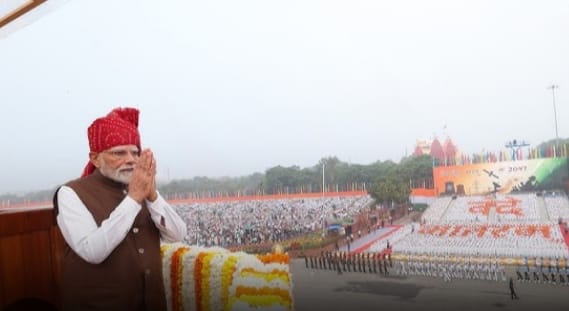
In any democracy, the most disturbing threat to freedom is not always censorship. Sometimes it is the language used to discredit those who disagree with power. Prime Minister Narendra Modi chose the solemn occasion of the 80th Independence Day celebration to warn the country about a new category of alleged internal enemies whom he called “dimagi Naxals” or intellectual Naxals. From the Red Fort, he urged citizens to “identify and isolate” those whom he accused of carrying a Naxal mindset and influencing government policy from within the system.
Naxals are citizens who are known to fight for land rights, tribal welfare and democratic rights of the populace. The name, which was derived from Naxalbari of West Bengal, represents a group of left progressive thinking people who believed in Parliamentary democracy and often many of them, in the past, have joined mainstream electoral frays to present their thoughts to a larger audience. The voice of the weak and underprivileged invariably goes unheard. Unfortunately, most political parties in India, throughout the past eight decades, have tried to suppress these voices of the poor. These political parties have consciously nurtured societal divisions for their own benefits. In other words, they have all spent time, immense energy and wealth to ensure Indian society remains fragmented. Congress, Mulayam’s Samajwadi Party, Lalu’s party and even the Dravida parties have thrived solely on divisions. The BJP too has been, since the inception of its mother organisation, the RSS, a century ago, has sought a division which belittles Dalits first and minorities second, in its efforts to build a cohesive Hindu vote bank to win elections and retain power.
This new kind of ‘insidious’ uprising, as seen recently in Jantar Mantar, Ranchi and elsewhere, seems to have unnerved the traditional thinking of Indian politicians. For far too long, they have dealt with the common voter through their workers and intermediaries. These middle people are mostly those hopefuls who wish to be direct beneficiaries of the largesse of the party they support, if it comes to power. Starting at the lower levels of contractors, builders, dealers, gas and petrol station owners, moving on to middle and large businessmen and industrialists who throw in the bucks. These are predictable people, and this system had been trustworthy till this convenient apple cart has been suddenly overturned by teenagers and youngsters. The visual change that most would have noticed came in the form of reels made by the protesters in Jantar Mantar. Unlike previous instances where protesters were seen running helter skelter when the police would start baton charge, these youngsters were shooting videos, taking the lathi charge stoically and asking the cops if they had instructions to beat more or was this enough. Making a joke of the Establishment and using unparliamentary words seems to have made the powerful and rich lose their cool. It is difficult for the aged Indians to comprehend this new challenge.
They have never faced this kind of opposition earlier. Scared and out of their wits, the effort now is to slot this new breed as ‘intellectual naxals’ where the powers that be, unwillingly, admit the new weapon of struggle is intelligence, education and empathy. Power no more flows out of the barrel of guns. Power in the 21st century seems to flow out of brains and understanding.
India’s political set up has to overhaul and modernise itself, or it will simply perish. Blaming and name-calling the future generation will only make matters worse as it clearly demonstrates non-comprehension.