
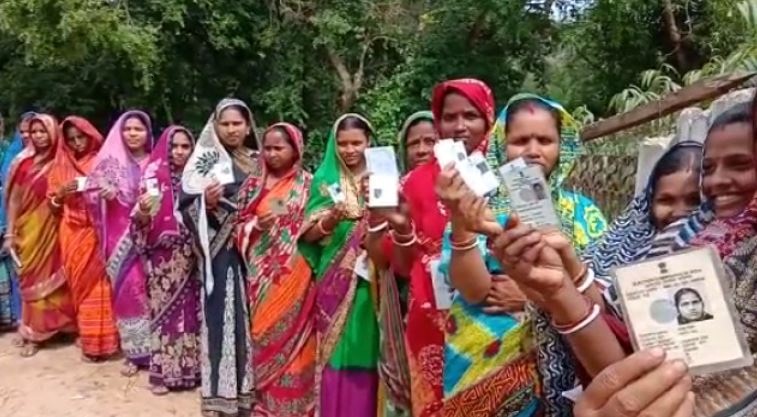
Kolkata: The TMC and BJP, through promises made in their respective manifestos for the West Bengal polls, have made it clear that they are fighting to woo the same bloc of voters “ women, youth and welfare scheme beneficiaries “, even as they seek to shape the contest through different pitches on identity, minorities, polarisation and nationalism.
While Chief Minister Mamata Banerjee is banking on the social coalition of women, minorities and SC-ST voters that has kept the TMC in power since 2011, the BJP is trying to upend that base through financial aid promises, highlighting Bengali pride, vows to implement the Uniform Civil Code and provide citizenship for Hindu refugees, besides its anti-infiltration rhetoric.
The Left Front and Congress have also unveiled their respective manifestos. But unlike the TMC and BJP, which are battling to capture power, they appear to be fighting mainly to reclaim political relevance through promises centred on jobs, industry and anti-incumbency.
Political analyst Biswanath Chakraborty summed up the poll manifestos this way: “The manifestos reflect their ideological and political positioning. The TMC is fighting to hold together its old social coalition. The BJP is fighting to break it with its own mix of promises and ideological push. The Left and Congress are fighting to remind voters that they still exist.”
If the TMC manifesto seeks to preserve its social coalition, the BJP’s ‘Sankalp Patra’ is an attempt to prise that coalition apart seat by seat, community by community and grievance by grievance.
The party has doubled down on the formula that transformed Banerjee from a street-fighter into perhaps the country’s most durable regional leader — direct cash transfer, women-centric welfare schemes and careful outreach to minorities and backward communities.
The proposed hike in Lakshmir Bhandar to Rs 1,500 for women in the general category and Rs 1,700 for SC and ST women is not merely a welfare announcement. It is TMC’s attempt to consolidate women, who have repeatedly turned out in greater numbers than men and rescued the party whenever anti-incumbency threatened to gather force.
“Those who want to divide West Bengal in the name of religion should know that the state stands with its mothers, daughters, minorities, majority and the poor,” TMC leader Jaiprakash Majumdar said, projecting the election as a battle to protect the state’s social cohesion.
The BJP has recognised that women are the TMC’s strongest fortress. Its response is not to bypass it, but to storm it.
Union Home Minister Amit Shah promised Rs 3,000 a month for every woman, free bus travel, 33 per cent reservation in government jobs and a network of women police stations and ‘Durga Suraksha Squads’.
The BJP believes that below the surface of the TMC’s welfare success lies anger over crimes against women, the RG Kar outrage, Sandeshkhali incidents and a wider feeling that the state has become unsafe. Shah repeatedly spoke of ‘respect’, ‘security’, and ‘fear-free living’, trying to convert social anxiety into political anger.
The TMC manifesto also speaks directly to West Bengal’s Muslims, who account for nearly 30 per cent of the electorate and influence results in more than 110 seats. Promises on Waqf properties, Aliah University and skill training in minority areas are meant to reassure a constituency unsettled by the BJP’s growing aggression and by fresh tensions over the Waqf issue.
The BJP, in contrast, has made that very polarisation the centrepiece of its campaign. Its promise to implement the Uniform Civil Code within six months if it comes to power, coupled with vows to stop infiltration, detect and deport illegal immigrants and enact laws against ‘Love Jihad’ and ‘Land Jihad’, is a calculated attempt to consolidate Hindu votes.
“This election is a contest between appeasement and justice, infiltration and security, corruption and development,” BJP leader Debjit Sarkar said.
For the BJP, a sharply polarised election is perhaps the quickest route to neutralise the TMC’s welfare edge. For the TMC, the sharper the BJP’s Hindutva pitch becomes, the easier it is to pull minorities and secular-minded voters back into Mamata Banerjee’s camp.
The TMC promises scholarships, hostels and tribal benefits in SC-ST belts where the BJP made deep inroads in 2021. The BJP counters with the promise of recognition for Rajbanshi and Kurmali languages and a north Bengal package loaded with an AIIMS, IIT and IIM.
The BJP has also attempted a subtler correction. After years of being painted by the TMC as an outsider party run from Delhi, it has wrapped its manifesto with Bengali pride. Shah promised a Vande Mataram Museum, Tagore cultural centres, a Chaitanya Mahaprabhu circuit and even assured Bengalis that nobody would stop them from eating fish and eggs.
The message was unmistakable: the BJP no longer wants to appear merely as the party of Hindutva in West Bengal; it wants to become the party of ‘Bengali Hindutva’.
The Left Front and Congress, fighting to remain relevant in a bipolar contest, have chosen a different route altogether. Both have tried to shift the debate from identity to employment.
The Left has promised one permanent job in every family, urban job guarantees, expansion of industry and new software and hardware parks.
The Congress, meanwhile, has built its campaign around a softer version of the TMC model. It has promised monthly assistance for women, a larger health cover and immediate filling up of vacant government posts, effectively arguing that the ruling party’s welfare politics can continue without the baggage of corruption and anti-incumbency.
With polling nearing, every promise is really a coded appeal to a particular voter bloc, every welfare scheme, identity pitch, and slogan carefully designed to shift the electoral arithmetic.