

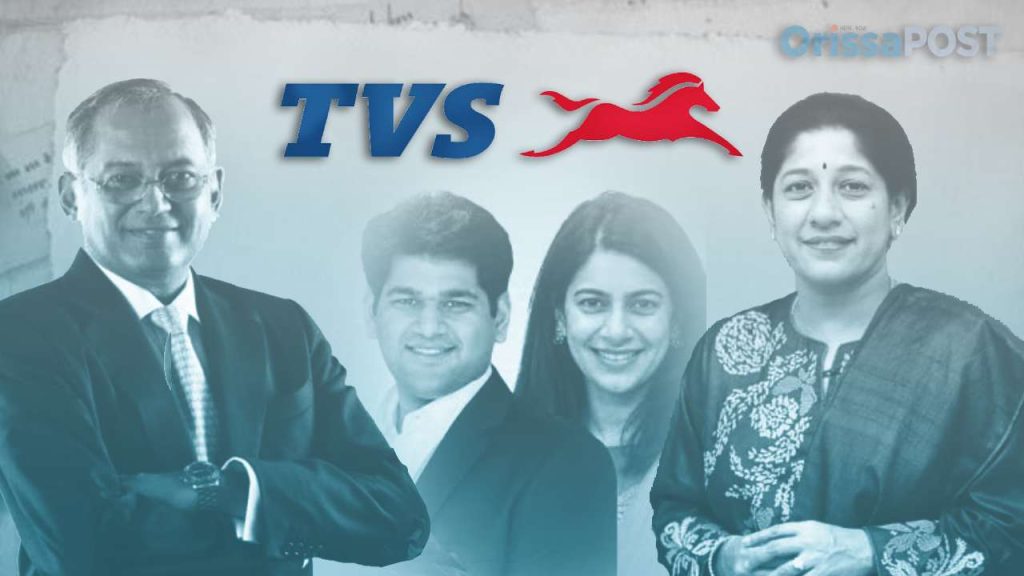
New Delhi: Lakshmi Venu, a member of the TVS industrial family, has formally sought a partition of the joint family assets of her father Venu Srinivasan’s branch, escalating a succession dispute that could have implications for ownership and control of key businesses within one of India’s best-known automobile groups.
In a partition notice to her father, Lakshmi called on him, as head of the family, to discharge his fiduciary duties and ensure a “fair and lawful partition,” according to a statement from her office Monday.
Her mother, Mallika Srinivasan, has publicly backed her claim, exposing a deepening rift within the family over the distribution of its wealth.
Lakshmi maintains that she is entitled to an equal share under the Hindu Succession Act, 1956, as amended in 2005, and has an independent right to seek partition. She has invoked Section 6 of the Act, which recognises daughters as coparceners with the same rights as sons in qualifying Hindu joint family property.
The claim covers family interests held through the VS Trust and other holding structures, including stakes in TVS Holdings, TVS Motor Company, TVS Credit Services and Sundaram-Clayton, businesses and assets allotted to the Venu Srinivasan branch under the broader TVS family arrangement of 2020.
At the heart of the dispute is whether the 2020 division of the wider TVS Group, followed by a separate memorandum of understanding signed by the four members of the Venu Srinivasan family in March 2024, also settled the economic interests of the immediate family.
Venu Srinivasan and his son, Sudarshan Venu, maintain that a settlement has been reached, while Mallika and Lakshmi contend that no comprehensive economic partition of the family’s assets has been completed. The four represent the third and fourth generations of T.V. Sundaram Iyengar, founder of the TVS Group.
The 2020 arrangement divided business interests among four principal branches of the larger TVS family following a valuation and allocation of assets. The Venu Srinivasan branch took control of key group companies. However, Lakshmi argues that the broader family settlement did not constitute a partition within her immediate family and that no division of its underlying assets was “ever initiated, let alone concluded”.
The March 2024 MoU, signed by all four family members, has emerged as a central point of contention. Venu Srinivasan and Sudarshan regard it as part of the family settlement, while Mallika and Lakshmi maintain that it primarily dealt with the use of TVS brands and trademarks.
Under the understanding, Mallika and Lakshmi agreed not to use certain trademarks, including TVS, in businesses such as two- and three-wheelers and financial services. Lakshmi manages Sundaram-Clayton, while Sudarshan leads TVS Motor.
Lakshmi argues that the management or control of businesses cannot confer exclusive ownership or extinguish the legal rights of other family members. She alleges that beneficial interests in the family assets have been concentrated in favour of her brother, excluding her own lawful entitlements, and characterises this as both a breach of trust and a violation of law.
“Patriarchy has no place in law or in a progressive India,” her statement said, adding that daughters’ rights to joint family property cannot be overridden through unilateral decisions or corporate arrangements.
The dispute surfaced publicly in October after TVS Holdings disclosed that Sudarshan had been identified as a significant beneficial owner through trust structures. A subsequent statement from Lakshmi and Mallika questioned the arrangements governing the family’s economic interests.
TVS Holdings’ annual report shows that the family and promoter group hold 74.45 per cent of the company, with Venu Srinivasan holding 66.55 per cent through the VS Trust. TVS Holdings, in turn, owns 56 per cent of TVS Motor, making the dispute over the trust and its beneficial interests significant for the ownership structure of the listed businesses.
Venu Srinivasan has maintained that the assets concerned are his personal assets and that their allocation between his children was fair and equitable. The disagreement has since moved towards the legal arena, with Venu and Lakshmi filing caveats against each other in court, anticipating possible proceedings concerning the family assets.
The legal question is likely to turn not only on the Hindu Succession Act but also on the nature and ownership of the assets in question, the terms of the family arrangements and the legal status of the various trust and corporate structures.
The 2005 amendment to the Hindu Succession Act gives daughters equal coparcenary rights by birth in qualifying Hindu joint family property. In its 2020 judgment in Vineeta Sharma v. Rakesh Sharma, the Supreme Court affirmed that these rights do not depend on whether the father was alive when the amendment came into force. However, the application of those provisions to the assets claimed by Lakshmi will depend on their legal character and ownership.
A court-supervised partition, if pursued and granted, could potentially alter the distribution of beneficial interests within the family and have wider implications for the ownership structure of companies held through the family’s trust arrangements.
Despite the escalation, Lakshmi has reiterated her preference for an amicable and equitable resolution.
Mallika Srinivasan, backing her daughter’s claim, said: “It is unfortunate that requests for an amicable settlement have not so far progressed in a meaningful and timely way. As a mother, to me, a son and daughter are equal in every respect. I do believe that Lakshmi has a legitimate share of the family assets, not unequal to that of Sudarshan’s. I reiterate that this is a matter to be settled, in the interests of all stakeholders, through transparent dialogue, with equity, clarity and amity. I sincerely hope that we can move forward constructively, with grace and dignity.”
PTI