
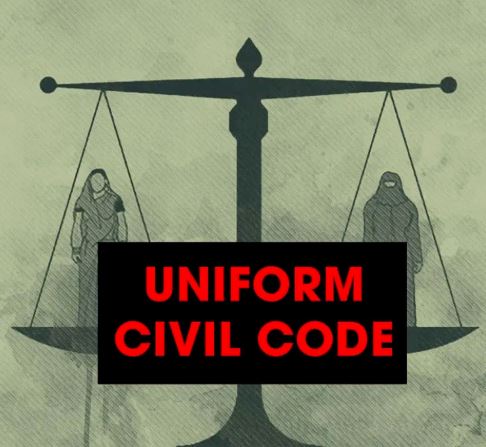
Union Home Minister Amit Shah’s announcement on 13 September of the government’s resolve to enforce the Uniform Civil Code (UCC) in 21 states ruled by the BJP-led National Democratic Alliance (NDA) before the 2029 Lok Sabha polls has made it clear the BJP will go back to its core Hindoo majoritarian agenda as its main poll plank in the next Lok Sabha elections. It appears the party is now left with no other option but to divert the country’s attention from the groundswell of protests by the youths and students against its rule, failing to fulfil their basic aspirations for corruption-free academic exams, educational infrastructure worth the name, jobs and a secure future.
The BJP promised the UCC in most of its earlier elections but more so in 2024 election manifesto, but the current move turns out to be a rather misnomer. For, instead of implementing an overarching UCC for the entire nation, the party has chosen to frame legislations by individual states where discrepancies are bound to occur as have already happened in the case of the UCC adopted in four states – Uttarakhand, Assam, Gujarat and Madhya Pradesh. The debate on the desirability of the UCC in the country with a plethora of religious practices, customs and laws governing personal and social relationships such as marriage, divorce and inheritance has been continuing since Independence. There are grey areas in the laws, constitutional provisions, religious freedoms and social harmony in the country’s rich secular heritage resting on unity in diversity. That is why the matter has been hanging fi re for decades as the difficulty to address different concerns of different personal laws with a common legal framework is stupendous.
It is not merely a legal-constitutional question, but a social-religious issue. While a uniform set of laws governing civil life has long since been considered a part of social reform in India, under the BJP the implementation of a UCC has often been weaponised to marginalise and penalise women, Moslems and Christians. Then there is the huge issue of whether the Scheduled Castes and Scheduled Tribes will be willing to accept subservience to the new law where they will, most probably, be totally left defenceless. The drift of the Home Minister’s statement leaves no one in doubt about the ruling party’s agenda for the next LS polls. He has equated the move with the NDA government’s other controversial legislations, including the removal of Jammu and Kashmir’s special status through the abrogation of Article 370 and the abolition of triple talaq. He also added that the government is equally determined to use another political weapon of the National Register of Citizens (NRC) about which it is consulting its “alliance partners and various groups in Manipur.” The idea of a UCC in India has been the subject of sustained debate since Independence.
In essence, a UCC proposes a single set of laws to govern personal matters such as marriage, divorce, inheritance, adoption, and property rights for all citizens, irrespective of religion, caste or gender. It seeks to consolidate the various religion-based personal laws presently in force in the country into a unified secular code. The proposal concerns not only legal uniformity but also social justice, equality, and national identity. Those who support the UCC regard it as a vital expression of the Indian Constitution’s vision of a secular and democratic society. They contend that legal uniformity would extend equality and justice to all citizens, regardless of religious or cultural background and would modernise a legal system they consider outdated and divisive. The opponents of the UCC voice concerns about a possible encroachment on the cultural and religious diversity that the Constitution protects. They argue that India’s strength lies in its pluralistic society, in which religious communities manage their internal affairs in accordance with their own traditions.
In their opinion imposing a UCC on all religions may be seen as a breach of the right to religious freedom guaranteed by Article 25 of the Constitution. Some maintain that personal laws form part of religious identity and that uniformity would erode a cultural fabric that is centuries old on this land. This concern is especially acute for minorities, particularly the Moslem community, who fear that a UCC might tend to accommodate practices of the majority Hindoo community while neglecting their own.
As such, the whole exercise reignites the debate on religious freedom, gender equality, minority rights, and national integration. It raises issues concerning state intervention in personal law, protection of religious autonomy and the need for gender-sensitive legal structures. The timing of the announcement is significant.
The BJP’s image has taken a severe beating after millions of youths and students have exposed the government’s colossal neglect of their problems and brutal oppression of their legitimate protests by a lathi-charging police force. The government’s youth outreach programmes to address their concerns ring hollow and has turned out to be too little too late. It now seems desperate because it is left with no other choice but to use the communal card in the garb of constitutional-social reforms to move forward.