
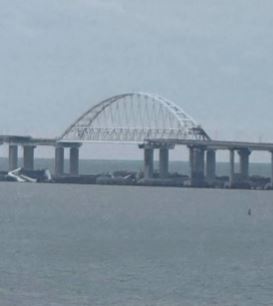
Kyiv/Moscow: Ukrainian drones and missiles destroyed the central road section of the bridge linking Russia and Crimea Tuesday, inflicting a military and symbolic blow on President Vladimir Putin two days before he is due to meet the leaders of China and the US. Videos and images posted on X by Ukrainian President Volodymyr Zelenskky and verified by Reuters showed the bridge’s main road arch had crumbled into the sea, leaving a yawning gap. “Russia strikes our infrastructure every day, including bridges,” Zelenskiy said. “We are … reminding Russia that war will always return to where it began.” The 19-km (12-mile) bridge is a flagship project inaugurated by Putin in 2018 and a symbol of Russia’s attachment to the peninsula it captured and annexed from Ukraine in 2014. The timing was awkward for the Kremlin leader ahead of his meeting in Shenzhen Thursday with US President Donald Trump and China’s Xi Jinping, where the three are expected to discuss the Ukraine war among other topics. Zelenskiy said the strike followed an unprecedented operation that methodically destroyed Russian air defences, radar systems and electronic warfare capabilities.
Grateful to the Security Service of Ukraine, all units of Ukraine’s Defense Forces involved, Ukraine’s Minister of Defense, the Commander-in-Chief of the Armed Forces of Ukraine and the General Staff, and all our weapons manufacturers for an unprecedented operation in response to Russian strikes on our infrastructure.
Today, everyone can see the consequences for the main military crossing from Russian territory into our Ukrainian Crimea. This is the result of the seventh stage of an operation carried out over several weeks, developed and coordinated by the Security Service of Ukraine together with the General Staff of the Armed Forces of Ukraine. Our warriors gradually destroyed air defense systems, radars, electronic warfare equipment, and other designated targets on the way to the final objective. For this, they used “Dovbush,” “Vendetta,” “Da Vinci,” “Sichen,” “Mich-2000,” “Ruta,” “Palianytsia,” “An-197,” “FP-1,” “FP-5 Flamingo,” and “R-360 Neptune.”
Today, at the key stage, the “Palianytsia” drones performed exceptionally well, striking the road section of the bridge, while “Neptune” missiles, “Ruta” drones, and FP-5 drones struck the railway section. Using “Flamingo,” our warriors carried out a precision-guided strike – and the communications uplink worked flawlessly until the very last seconds.
We have repeatedly offered Russia steps toward de-escalation – and every proposal has been met with loud rejection. Russia strikes our infrastructure every day, including bridges in Zaporizhzhia, Dnipro, Kyiv, and the Odesa region. We are restoring our infrastructure. But we are also reminding Russia that war will always return to where it began. Ukraine’s defensive capabilities are strong and will remain so, and we will never leave terror against our cities and people unanswered.
I thank the true warriors of the Security Service of Ukraine, all our Defense Forces, our intelligence agencies, and EVERY manufacturer of weapons effectively used to defend Ukraine, Ukrainians, and our national interests. Glory to Ukraine!
— Volodymyr Zelenskyy / Володимир Зеленський (@ZelenskyyUa) November 17, 2026
KREMLIN SAYS RUSSIA WILL REBUILD IT
Putin’s spokesman Dmitry Peskov said a repair plan would be prepared, making the bridge “even better than before”. But Russian military bloggers said repairs would be exceptionally challenging given Ukraine’s capacity for further attacks. Finnish military analyst Emil Kastehelmi posted on X, “The road bridge won’t be repaired during this war … Ukraine has achieved a victory with both concrete and symbolic implications.”
IMPLICATIONS FOR SHIPPING
The bridge spans a channel used by commercial vessels entering and leaving the Sea of Azov, making it an important part of the region’s grain export network. While Black Sea grain shipments have largely stalled amid escalating drone attacks, export infrastructure has suffered limited damage, meaning trade could resume quickly if security conditions improve. Andrey Sizov, of consultancy Sovecon, said the bridge’s collapse could “substantially delay any eventual resumption of shipping from the Sea of Azov” because debris would have to be cleared from the channel.
Orissa POST – Odisha’s No.1 English Daily