
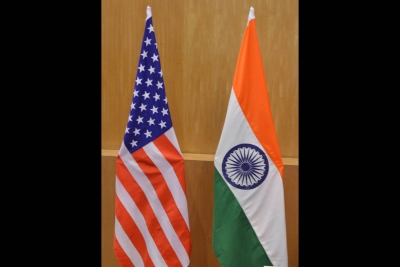
New Delhi: A US team is visiting India from June 1-4 to discuss finalisation of the details for the interim trade pact and take forward negotiations under the broader bilateral trade agreement (BTA), the commerce ministry said Wednesday.
The US team will be led by its chief negotiator, Brendan Lynch.
The two sides are “proposed to finalise the details of the interim agreement and take forward the negotiations under the broader BTA on multiple areas such as market access, non-tariff measures, customs and trade facilitation, investment promotion, and economic security alignment,” it said.
February 7, India and the US issued a joint statement finalising the contours or framework of the first phase of the bilateral trade agreement (BTA) or an interim trade agreement. Now, both sides will have to finalise the legal text for that deal.
The framework reaffirmed the countries’ commitment to the broader India-US BTA negotiations.
According to that framework, the US had agreed to reduce tariffs on India to 18 per cent from 50 per cent. It had removed the 25 per cent tariffs on Indian goods for buying Russian oil and was to cut the remaining 25 per cent to 18 per cent under the pact.
But, February 20 this year, the US Supreme Court ruled against President Donald Trump’s sweeping reciprocal tariffs, which were imposed under the 1977 International Emergency Economic Powers Act (IEEPA).
After that, the US President announced the imposition of 10 per cent tariffs on all countries for 150 days, starting February 24.
In light of these changes, a meeting between the chief negotiators of India and the US scheduled for February was postponed. The two sides met in Washington last month, when the Indian team, headed by its chief negotiator Darpan Jain, visited America from April 20-23, 2026.
“To carry forward the discussions, the US team led by the Chief Negotiator will be visiting India from 1-4th June 2026,” the ministry said in a statement.
Commerce Secretary Rajesh Agrawal said the huge potential for mutual cooperation “and the complementarity inherent in the economies of the two countries, will make the upcoming deal great news for all stakeholders”.
As the tariff landscape has changed in the US, both sides may like to re-examine the framework of the agreement.
Under the agreed framework, India proposed to eliminate or reduce tariffs on all US industrial goods and a wide range of US food and agricultural products, including dried distillers’ grains (DDGs), red sorghum for animal feed, tree nuts, fresh and processed fruit, soybean oil, wine and spirits, and additional products.
New Delhi has also expressed its intentions to purchase USD 500 billion of US energy products, aircraft and aircraft parts, precious metals, technology products, and coking coal over the next five years.
The June meeting will be important, as India enjoys a comparative advantage over its competitor countries. Now, with all US trading partners facing a uniform 10 per cent tariff, the pact requires recalibration.
Further, the US Trade Representative (USTR) in March had also launched two unilateral investigations under Section 301 of the Trade Act of 1974 against a number of countries, including India, over excess capacity and failures to eradicate forced labour in global supply chains.
India has strongly rejected allegations made by the US Trade Representative in those two investigations and has requested that the probes be initiated, as the initiation notice has failed to provide a cogent rationale to substantiate the claims.
US Ambassador Sergio Gor has recently stated that the United States is optimistic about concluding the proposed bilateral trade agreement with India in the coming months.
US Secretary of State Marco Rubio was on a four-day trip to India last week.
The two countries Tuesday firmed up a key framework for cooperation in ensuring steady supplies of critical minerals, a move that comes amid growing concerns over China’s export controls on rare earth elements and strategic metals vital for global technology supply chains.
The framework on securing supplies of mining and processing of critical minerals was signed on the sidelines of the Quad foreign ministers’ meeting in New Delhi.
The US was the second-largest trading partner of India in 2025-26. India’s outbound shipments to the US grew marginally 0.92 per cent to USD 87.3 billion during the last fiscal year, while imports increased 15.95 per cent to USD 52.9 billion. The trade surplus declined to USD 34.4 billion in 2025-26 from USD 40.89 billion in 2024-25.