
Bhubaneswar: Odisha’s heritage lives not only in royal chronicles, monumental temples and protected archaeological sites, but also in caves, village festivals, weathered palm-leaf manuscripts, wooden images and oral traditions passed down through generations.
Sunday’s heritage walks in the Chilika-Barakul region and Dhenkanal brought several of these lesser-known cultural landscapes into public view. While the Dhenkanal Heritage Walk continued an established local initiative, the Chilika Heritage Walk (CHW) marked the beginning of a new effort to explore and interpret the region’s cultural identity through community participation.
The initiative was signifi cant as it extended Odisha’s growing community heritage movement into a region better known for its ecological importance than its cultural heritage. The CHW was organised by the ODI ART Centre under the leadership of Bisheswar Das and Sushant Kumar Dash.
The walk began near the historic Maa Narayani Temple. Although the present structure belongs to a later period, the original shrine is believed to predate the 12th century AD. Some archaeological accounts associate its foundational elements with as early as the 7th century AD, during the Bhaumakara period.
The temple’s later history is closely associated with the Zamindars of Khallikote. In the early 18th century, the Khallikote rulers undertook extensive renovation, transforming what was once a shrine in a forested setting into a formal stone temple. From the temple, participants moved to Debijhara near Barkul, a serene natural reservoir and viewpoint nestled in the foothills of the Eastern Ghats. With its expansive water body framed by rugged hills, the scenic location has earned the affectionate nickname “Second Chilika” among local explorers for its striking combination of hill and wetland landscapes.
The landscape also became a canvas for young participants. More than 20 students from Venkateshwar English Medium School in Barkul and fi ve students from Khallikote Art College documented their impressions of the temple and produced colourful paintings inspired by the vistas of Debijhara. The initiative also highlighted the role of the ODI ART Centre, an ethnic art complex dedicated to preserving and presenting Odisha’s folk and tribal artistic traditions.
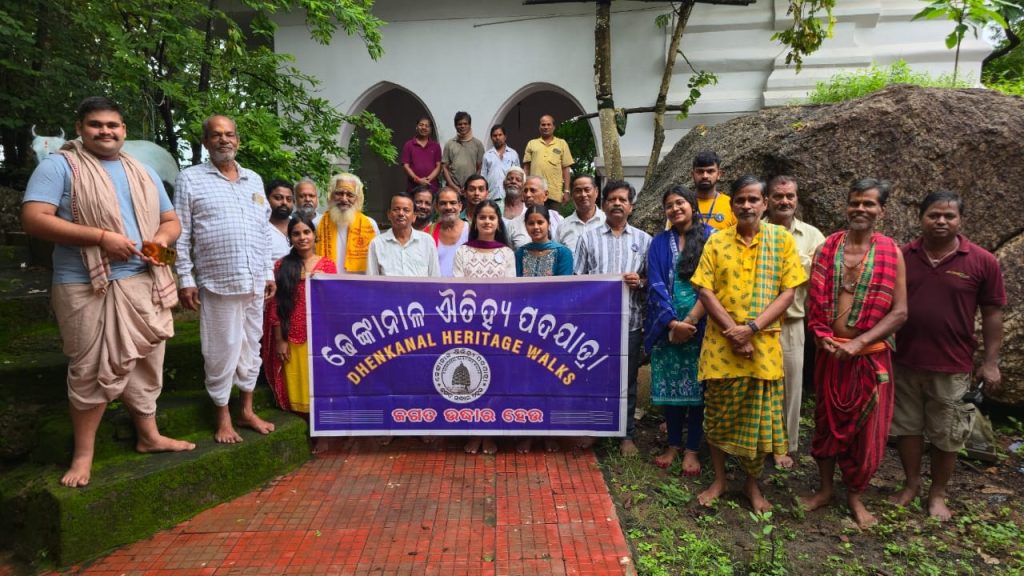
Participants were encouraged to look beyond the idea of folk and tribal art as museum objects and understand these traditions as living practices sustained by artists, craftspeople, performers and ritual communities. Meanwhile, the 40th Dhenkanal Heritage Walk (DHW) was organised at the historic Gumpha Jagannath Temple, also known as Harihara Ashram, in Gandia block.
Set amid a tranquil natural landscape, the ashram has been regarded by monks and devotees as an important centre of Jagannath culture for nearly two centuries. Participants explored the Jagannath and Shiva temples, the caves, locally preserved traditions and the surrounding natural environment. A local trust, formed by community members, has played an important role in maintaining the site and conducting rituals and festivals, including the annual Rath Yatra. The heritage walk was organised under the leadership of DHW convenor Suresh Prasad Mishra.
According to local tradition, around 200 years ago, a saint installed the Chaturdha deities inside a cave at Duburi and worshipped them there. Following his death, local devotees continued the tradition and eventually constructed a temple at the site.
Several caves dot the hill, with idols of different gods and goddesses installed inside them. A Shiva temple has also been built on the hill. The two heritage walks revealed distinct yet interconnected dimensions of Odisha’s cultural past.