
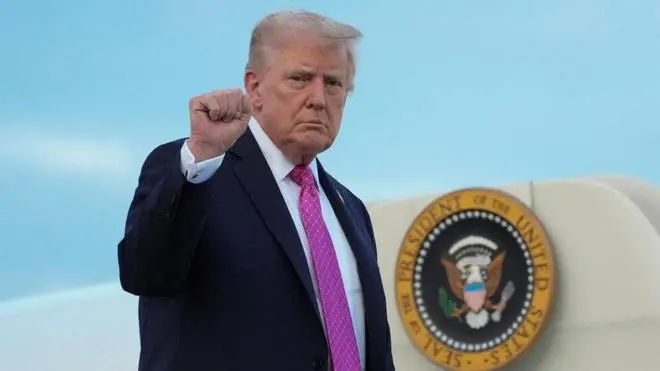
The big question being asked 24 hours after US President Donald Trump announced a five-day pause on the ongoing US-Israel war on 23 March is whether any talks were held at all, as claimed by Trump, between the US and Iran to end the ongoing war. Iran has not only dismissed Trump’s claim but also accused him of buying time to launch fresh offensives. Standing beside Air Force One, Trump tried his best to sell his sudden change of mind and talked about detente with little detail as a US ultimatum to bomb Iran’s power plants loomed unless Tehran opened up the Strait of Hormuz. The about turn came just hours before US markets were to open for what looked like another punishing round of trading on the day. The markets did ease to some extent immediately after the announcement and started recovering from the oil shocks. True, military strategies or peace deals are not discussed at a Press conference. But Trump’s evasiveness and the subsequent denial of any negotiation by Iran makes his motive suspect. Asked who the US was negotiating with in Iran, Trump said: “We are dealing with a man that I believe is the most respected.” Pressed further, he said he could not name the person lest he should get killed. The little hints that he dropped about the terms of a deal are an exercise in obfuscation. He said Iran would not have a nuclear weapon, but control over the Strait of Hormuz would be held by “maybe me, me and the Ayatollah … whoever the next Ayatollah is.”
On 24 March Trump seemed to be shifting the blame for the war on his Secretary of War Pete Hegseth. Trump said that Hegseth was the “first one” to suggest attacking Iran when he discussed the “problem in the Middle East” with his close aides. Mohammad Bagher Ghalibaf, the speaker of the parliament of Iran, who previously served as an Islamic Revolutionary Guards Corps commander, has already denied that he or anyone in Iran’s government is speaking with the US. According to him, Trump’s sole intent is to mitigate the financial damage done by Iran’s closure of the Strait of Hormuz. He insisted fake news is used to “manipulate” the financial and oil markets and escape the “quagmire in which the US and Israel are trapped.” While India continues to adopt a policy on the war that is neither here nor there, Pakistan, an ally of Iran, seems to be emerging as a key player in working out a negotiated resolution of the conflict. Iran’s foreign ministry has said that in recent days it received messages from some friendly countries indicating a US request for negotiations aimed at ending the war.
A spokesperson of Iran, Esmaeil Baqaei, who indicated the involvement of Pakistan and some other countries in the process to end the war, denied there were ongoing talks directly between Iran and the US. It appears talks are being held through mediators, for which neither Trump would divulge details nor Iran would admit it till any concrete deal takes shape. That is why UK Prime Minister Keir Starmer asserted he was aware of the talks, while Israeli Prime Minister Benjamin Netanyahu said he had spoken with Trump and sought to present a potential deal as one that could safeguard Israel’s interests. The latest negotiations may also be another way for Trump to buy time, especially with oil and energy markets. The Pentagon is still moving marines and airborne soldiers into position. This gives rise to speculation that the US may in the coming days launch a strike or go for the potential occupation of Iran’s islands or coastline that would allow the reopening of the Strait of Hormuz in case diplomacy does not, in the end, yield any results. Significantly, a Pakistani official has reportedly told the media Islamabad may host direct talks between Iran and the US. According to him, US Vice-President JD Vance as well as Trump envoys Steve Witkoff and Jared Kushner are expected to meet Iranian officials in Islamabad this week. Trump had a phone call with Pakistan’s army chief, Asim Munir, the official said. If there is truth in the claim, a breakthrough may be expected even though both sides are making cautious moves.
Since last couple of days, the sole aim of the war seems to have become the opening of the Strait of Hormuz which, interestingly, was open till the beginning of the war. Now the rest of the countries can only wait till the end of the 5 Days period and see what happens.