
New Delhi: Commerce Minister Piyush Goyal Friday said India is watching developments following the US Supreme Court’s verdict against tariffs, pointing out that the joint statement on the proposed interim trade deal provides for a rebalancing of the pact “should circumstances change”.
The minister’s remarks came on the heels of US President Donald Trump’s 10 per cent tariff against all trading partners for 150 days. The temporary 10 per cent tariff was imposed on February 24 after the US Supreme Court struck down President Trump’s April 2025 decision to impose reciprocal tariffs on all imports.
On February 24, Trump also announced further increasing the tariffs to 15 per cent.
“We’ll have to watch. And by the way, you must have read my joint statement that we had finalised with the US. It has categorically said that should the circumstances change, the deal would be re-balanced…to ensure that the balance of the deal is maintained on both sides,” he said when asked if India’s negotiating position will change after the verdict.
Also Read: Goyal brands Rahul Gandhi poster boy of negative politics
A joint statement issued on February 7 stated that in the event of any changes to the agreed-upon tariffs of either country, the US and India agree that the other country may modify its commitments.
Referring to this statement, Goyal said :”It provides that the sanctity of the deal is both ways”.
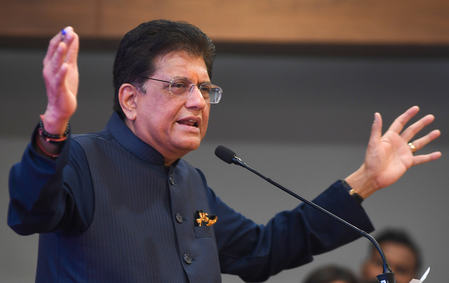
The minister was speaking at media event in New Delhi.
On February 7, the two countries announced that they have finalised the contours for the first phase of the bilateral trade agreement.
Under the pact, the US announced that it will bring down the reciprocal tariffs on Indian goods to 18 per cent from 25 per cent. The US has also removed the 25 per cent punitive tariffs on India, which were imposed for purchasing Russian crude oil.
Both sides also agreed to reduce import duties on a number of goods. India agreed to eliminate or reduce tariffs on all US industrial goods and a wide range of US food and agricultural products, including tree nuts, fresh and processed fruit, soybean oil, wine and spirits.
As per the pact, India has stated that it intends to purchase USD 500 billion of US energy products, aircraft and aircraft parts, precious metals, technology products, and coking coal over the next five years.
To finalise the legal text of the deal, chief negotiators of both countries were scheduled to meet this week in Washington, but the meeting was put on hold after the US Supreme Court’s verdict on Trump tariffs.
On February 20, the court struck down President Donald Trump’s sweeping global tariffs.
“It is an evolving situation. We’ll have to see. The Trump administration has made some comments…They have many other tools that they could possibly use (to impose new tariffs). They’ve already used one of them, Section 122, to put a 10 per cent tariff. I think they are on record that next week, they may increase it to 15 per cent for the first 150 days,” Goyal said.
When asked if the changes in tariffs provide incentives for India, the minister said it gives an opportunity to domestic firms to continue exports without hindrance.
“But bear in mind, the deal was better because it had many other elements…So till we finally ink it, I am not in a position to share every detail. Though all the sensitive matters have already been clarified. But I can assure you, there’s so many more positives to the deal that we should wait. Let us see how the situation moves forward,” he said.
He said that all the sensitive sectors such as dairy, soyameal, poultry, GM food, rice, wheat and corn are fully protected.
“Remember, trade deal or international trade is about comparative advantage… A trade deal is not only about what the tariff is. It is more about the competitive advantage that you get over your competition, and certainly at a 50 per cent tariff, we were at a huge disadvantage in our experts,” he added.
PTI