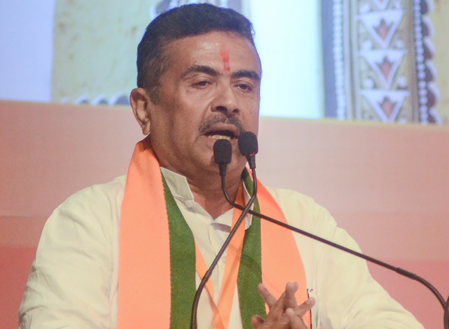
Kolkata: West Bengal Chief Minister Suvendu Adhikari said the state had, for the first time, invoked its newly enacted anti-goonda law against those accused of orchestrating violence during Friday’s NEET protest, warning they would face punishment their next three generations will remember.
Making a statement in the Assembly Saturday, Adhikari said around 70 people identified from the Dharmatala rally were not students and had no connection with the agitation over the alleged NEET paper leak.

Condemning the attacks on journalists during the protest, he said the West Bengal Public Safety and Control of Anti-social Activities Act, 2026 — popularly known as the Goonda Act — had been invoked to ensure exemplary punishment for those responsible.
I censure the attack on our journalist friends on behalf of the entire House. An attack on journalists is unacceptable. We will take such action under the Goonda Act that these goons and even their next three generations will remember it. This is precisely why this law was enacted, the chief minister said.
The law, passed by the Assembly recently after a stormy debate and criticised by the opposition as draconian, was approved by the governor earlier this week.
Saturday marked its first application in a criminal case, lending immediate political significance to a legislation the government had defended as necessary to tackle organised criminal elements.
Adhikari said seven FIRs had been registered over Friday’s violence — six at Hare Street police station and one at Entally police station — with provisions of the new law incorporated into the cases.
The police exercised maximum restraint despite repeated provocation. That was the clear instruction given to them. They did not fall into the trap, he told the House.
The chief minister said the rally, organised at Dharmatala against alleged corruption in education and the NEET paper leak, initially proceeded peacefully before anti-social elements entered from behind and attempted to trigger violence.
According to him, the protest had been organised under the banner of the United Cockroach March, announced by what he described as a self-proclaimed member of the CJP, with participation from Left and ultra-Left student organisations, including the SFI, DSO, DYSA and AISF.
In a democracy, everyone has the right to protest peacefully within the framework of law. The police were specifically instructed not to act unless the situation went completely out of control, he said.
Adhikari alleged that as the procession reached Dorina Crossing at Esplanade, shoes and water bottles were hurled first at policemen and then at journalists covering the demonstration.
They wanted the police to resort to lathi-charge and tear gas. They wanted a spectacle. But Kolkata Police did not provide them that opportunity. The restraint shown by the force deserves appreciation, he said.
He said six journalists suffered serious injuries and were treated at government hospitals, while several others sustained minor injuries.
The chief minister, who visited injured journalists at the state-run SSKM Hospital on Friday evening, said the attack on the media was an issue that had to be placed before the House.
I have personally met the injured journalists. What happened to them cannot be brushed aside. This House must unequivocally condemn such attacks, he said.
Seeking to draw a distinction between the protesters and those accused of orchestrating the violence, Adhikari said around 70 people had been identified through video footage and other evidence and that none of them was a student, CJP member, or connected with the NEET movement.
They have nothing to do with the student movement. They are not students, nor are they members of the organisation that called the programme. They came only to create disorder, he alleged.
Naming five alleged notorious criminals — Afroz of Rajabagan, Naheed of Kidderpore, Tanveer and Nizam of Ekbalpore, and Rahul Jamal of Watgunge — the chief minister alleged that they had played key roles in the violence.
We have identified these people. They are known anti-socials. Such elements will face the strictest action under the Goonda Act, he said.
He further alleged that activists of Left student organisations had infiltrated the programme and questioned whether many of them were genuine students.
Many of these so-called student activists have no existence in any college or university. They entered the rally under the banner of student organisations, he claimed.
The chief minister maintained that the incidents vindicated the government’s decision to introduce the anti-goonda legislation.
It is because of such activities that this law was brought. The governor has already assented to it after it was passed by this House. Today the people of Bengal can understand why such legislation was necessary, he said.
Police sources said five complaints were lodged by journalists and media organisations over the attacks, while another FIR was registered suo motu.
The cases include charges relating to unlawful assembly, rioting, obstruction of public servants from discharging their duties, offences committed by members of an unlawful assembly and incitement to violence.
Police said investigations were continuing to identify other participants through video footage.
The violence erupted during a march demanding the resignation of Union Education Minister Dharmendra Pradhan over the alleged NEET paper leak.
Police alleged that sections of the crowd attempted to attack personnel on duty and targeted journalists covering the protest.
The organisers of the demonstration and opposition parties, however, rejected the government’s allegations, accusing the police of acting against peaceful protesters and disputing the chief minister’s characterisation of those involved in the clashes.