
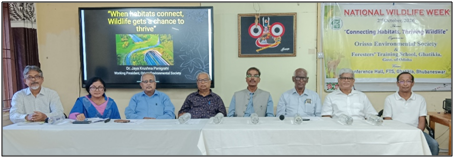
Bhubaneswar: The importance of protecting and restoring wildlife corridors to ensure the safe movement and long-term survival of animals was highlighted at a Wildlife Week programme organised by the Orissa Environmental Society (OES) in collaboration with the Foresters’ Training School, Ghatikia, Government of Odisha. Held at the conference hall of the Foresters’ Training School, the programme focused on this year’s Wildlife Week theme, “Connecting Habitats, Thriving Wildlife.”
Experts at the event stressed that healthy, connected habitats are essential for wildlife to access food, water and shelter, reproduce and migrate safely. Rapid urbanisation, agriculture, roads, mining and deforestation have increasingly fragmented natural habitats into smaller and isolated patches. Such fragmentation restricts the movement of wildlife and limits access to vital resources.
Experts said habitat corridors can help address these challenges by connecting forests, wetlands, grasslands and other ecosystems. The programme was held under the chairmanship of OES president Sundara Narayana Patro. Former PCCF, A&N, Arunachal Pradesh and Mizoram, Ashok Kumar Biswal, attended as the chief guest. Biswal explained that wildlife corridors are stretches of natural or restored land that connect fragmented habitats and enable animals to move in search of food, mates and safer habitats. He also highlighted their role in maintaining genetic diversity by allowing different wildlife populations to interact and reproduce. He said effective conservation of wildlife corridors requires coordinated efforts by governments, local communities, farmers, conservation organisations and citizens. Planting native trees, restoring degraded forests, protecting wetlands and developing wildlife crossings over or under roads are among the measures that can make landscapes safer for animals, he added. Amita Das, Deputy Conservator of the Foresters’ Training School, said restoring fragmented landscapes and allowing wildlife to move freely can help create a future in which both nature and human communities flourish.
OES president Sundara Narayana Patro emphasised the role of responsible land-use planning in reducing the destruction of important natural habitats. He called for greater efforts to provide wildlife with better opportunities to survive and thrive. Former PCCF (Wildlife) Bijay Ketan Pattnaik shared his experiences in wildlife management in Odisha, while OES working president Jaya Krushna Panigrahi pointed out that connected habitats benefit people as well as wildlife. Healthy forests, he said, help regulate the climate, protect soil, store carbon and maintain water supplies. Wildlife expert Lala A.K. Singh observed that connected habitats make wildlife populations more resilient and enable ecosystems to function more effectively.
OES secretary Manoranjan Mishra delivered the introductory address and explained the significance of the Wildlife Week theme. OES life member Ramesh Chandra Panda proposed the vote of thanks. A large number of trainee for esters, OES members and environmental enthusiasts attended the programme and took part in the discussion.
Orissa POST – Odisha’s No.1 English Daily