Khandpara: Until recently, residents of Kantilo, Khandapara, Sidhamula, Kiajhar, Khalisahi, Dholmara, Marddarajpur, Banamalipur, Balaramprasad, Ranichheli and Shikharpur in Nayagarh district used to wake up in the morning to the sound of hammering coming from blacksmith furnaces that dotted these villages.
This used to serve as an alarm bell for the villagers as the blacksmiths started their work very early in the morning. The demand for their product was such that they routinely worked overtime. However, with technology taking over the trade, people now prefer to work as migrant workers instead of engaging in blacksmith’s work. The fact that the demand for the blacksmiths’ products has diminished drastically also forced the people in this trade to migrate to other regions in search of work.


Now the sound of their hammers can hardly be heard. With passage of time, these furnaces have also changed for the worst. The family business of these blacksmiths is dying steadily.
This correspondent visited the above mentioned villages for a firsthand knowledge about the blacksmiths’ plights.
The pathetic financial condition of the people was evident while passing through Kantilo village. Earlier, most villagers here worked as blacksmiths.
Some elderly villagers, who were gossiping idly, told this correspondent, “We have seen a time when we could hardly get time to have a siesta. Our hands were full of orders. We were busy making things like agriculture equipment to products such as axes, billhooks, sickles, kitchen knives, tongs, nails and others.”
A mere look at their palms is enough for even a layman to gauge the volume of work they once undertook.
There used to be more than 100 blacksmith workshops in the villages mentioned above. The number has now drastically reduced to 25 to 30. These remaining workshops are bearing the onslaught of modernity as activities at these workshops are next to nothing.
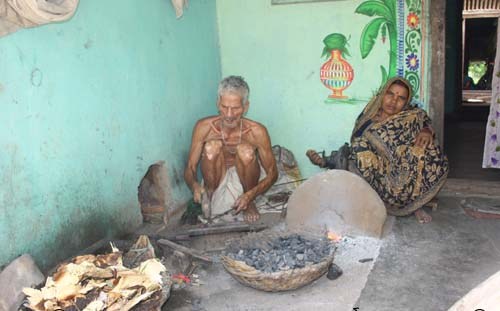
“Home equipment made of steel has swallowed our business, “claims Chhet Maharana, a Kantilo villager. He further says, “The future of blacksmith products is getting murkier. And the unavailability of labourers to work in our workshops has proved the last nail in our coffin.”
Chhet and his wife toil hard in their workshop from morning to evening. At the end of the day, they earn anything between Rs 200 and Rs 300 which fall short of their daily expenses.
Another blacksmith Krushna Chandra Maharana, who has managed to keep his family profession alive till, now, says, “Our workshop is 45 years old. It has been giving us food and clothes. But our income has come down drastically as there are cheap and readymade iron wares available in market. This is the reason why our children are not keen to continue this business, resultantly reducing the number of workshops,” he rues.
“Another problem that is to be equally thanked for the failure of our business is unavailability of raw material,” he further states, adding that at one point of time char coal – one of the prime raw materials – was available in abundance. They used to pay about Rs 50 to Rs 100 for two packets of char coal. Now the same quantity is selling for Rs 700 or even more. And the quality too is poor.
Supporting Krushna Chandra’s views, other blacksmiths said, “A piece of iron is not available at the same price as before. Its price has gone up manifold. We are also not getting the same number of takers for the traditional agriculture equipments we are manufacturing. Instead of coming to us, farmers these days go to markets where China and Rajasthan made products are available at a comparatively cheaper price,” they observed, adding their family business which has come down to them from generations has squarely failed to meet their daily family expenses.
PNN