
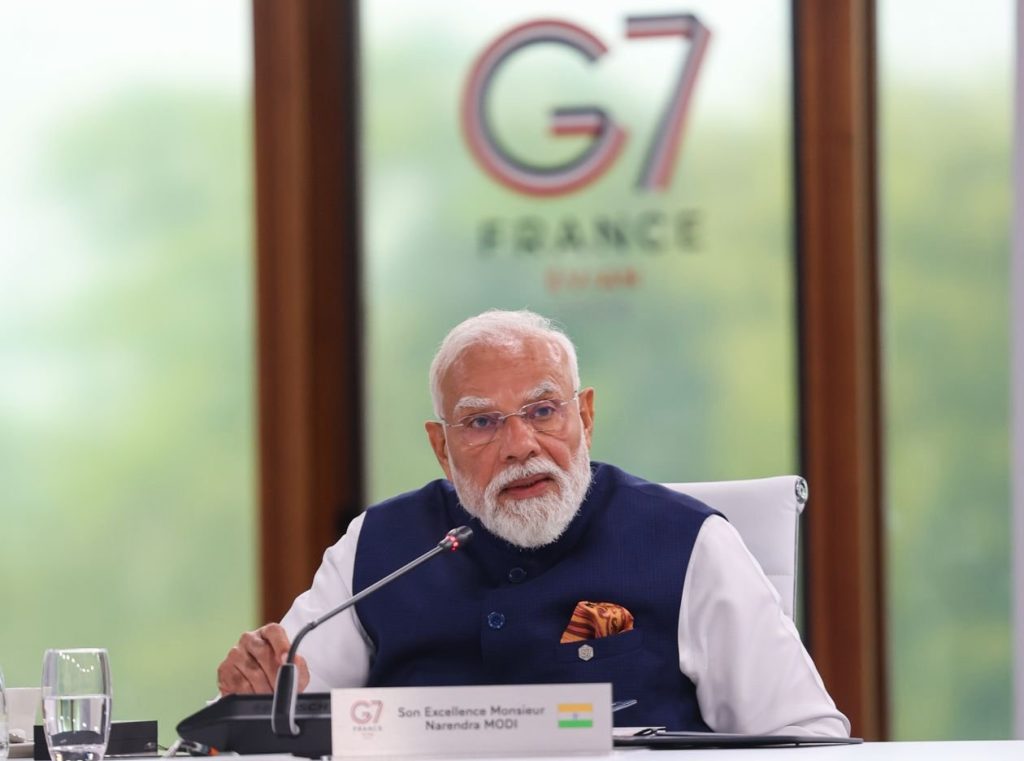
Evian-les-Bains: Prime Minister Narendra Modi Tuesday told the G7 leaders that the world should move from donor-recipient to partnerships based on solidarity and equality.
Speaking at the Outreach Session on ‘Forging New Partnerships and Rebuilding International Solidarity’ here, Modi also called upon nations to focus on building “trust and transparency” in global partnerships, especially in an increasingly interconnected world.
Prime Minister Modi, who was seated next to US President Donald Trump, said that the Global South has high expectations from the world community.
“However, what they seek is not merely support, but partnership. We must move beyond the donor-recipient mindset and work as equal partners. We must walk together and not merely alongside one another. Partnerships must be linked to dignity, not dependency,” Modi said.
“Through these efforts, we will lay a strong foundation for sustainable development for future generations,” he added.
The Prime Minister said that, in an interconnected world, where energy, food, health, cyber, and economic security are intertwined, building international partnerships was a necessity for the progress and prosperity of humanity.
He added that, in an uncertain world, trade and technology were being misused for narrow interests, leading to a trust deficit in the international arena.
“Mutual trust is the most important strategic asset today. But, sadly, today, the world does not suffer from a shortage of resources; it suffers from a shortage of trust. And the future of our partnerships depends on rebuilding this trust,” he said.
The session was attended by French President Emmanuel Macron, Italian Prime Minister Giorgia Meloni, Brazilian President Lula da Silva, President of the European Commission Ursula von der Leyen and British Prime Minister Keir Starmer, among others.
Modi said that India believes that the true test of partnership is not what we build for others, but what we enable others to build for themselves.
“Our experience shows that development is most effective when it is connected to the aspirations of people,” he said.
He underlined that India’s vision of international partnership is rooted in the timeless philosophy of ‘Vasudhaiva Kutumbakam’ – the world is one family.
India has always followed a ‘humanity first’ approach reflected in India-led International Solar Alliance, the Coalition for Disaster Resilient Infrastructure, the Global Biofuel Alliance, the Mission LiFe and Ek Ped Maa ke Naam initiatives, he added.
The Prime Minister emphasised that international partnerships and global solidarity can only be meaningful if we confront shared challenges collectively.
“India firmly believes that lasting solutions to the tensions and conflicts unfolding in various parts of the world are possible only through dialogue, diplomacy, and international cooperation,” he said.
PM Modi welcomed the progress made in peace efforts in West Asia, noting that this conflict has caused loss of life and property in friendly countries in the region.
He said that disruptions to maritime trade in the Strait of Hormuz have harmed the global economy.
“Many Indian citizens lost their lives. It is our responsibility to ensure the safety of the seafarers who connect all nations through global maritime trade. We must ensure that maritime routes remain safe and that seafarers can perform their duties without fear,” he said.
Last week, three Indian sailors were killed following the US military’s attack on a merchant vessel off the coast of Oman.
The Prime Minister conveyed that India “remains firmly committed to advancing sustainable and inclusive global development.”
“Shared my thoughts at the Outreach Session on ‘Forging New Partnerships and Rebuilding International Solidarity’ at the G7 Summit in Evian. In a world that is getting more interconnected and interdependent than ever before, this subject becomes all the more vital. But, partnerships can succeed only when they are founded on trust,” Modi later said in a post on X.
Before the start of the proceedings at the G7 Summit, Modi exchanged pleasantries with G7 leaders.
Modi arrived in Evian-les-Bains after concluding his two-day trip to Slovakia.
The Group of 7 (G7) brings together seven of the world’s most advanced economies: Canada, France, Germany, Italy, Japan, the United Kingdom and the United States. The European Union is also a member of the bloc.
The G7 serves as the forum of choice for its members to discuss and coordinate action in response to major economic, financial and geopolitical challenges on the global stage.
Orissa POST – Odisha’s No.1 English Daily