
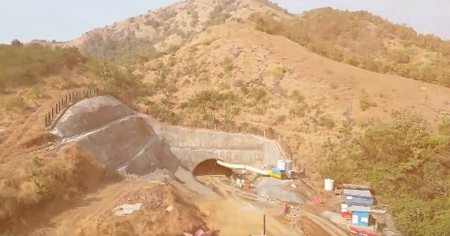
New Delhi: Railway Minister Ashwini Vaishnaw Friday virtually oversaw the key breakthrough of a 1.5-km-long tunnel of the bullet train project in Maharashtra’s Palghar district from Rail Bhawan in the national capital with chants of ‘Bharat Mata ki Jai!’
“The 1.5-km-long mountain tunnel is among the longest in Palghar district and is located between the Virar and Boisar stations on the bullet train route. It is the second tunnel breakthrough in Maharashtra, as the first 5-km-long underground tunnel between Thane and BKC was completed in September 2025,” according to a press statement issued by the Ministry of Railways.
Vaishnaw said, “The bullet train achieves nearly 95 per cent carbon dioxide savings compared to highways. This is a significant point. Many countries have implemented bullet train projects purely for environmental reasons.”
“South Korea, for instance, has also gained major economic benefits from such projects. Alongside the economic advantages, the environmental benefits are equally substantial. The train reaches city centres directly, minimising disturbance to people and traffic. It passes through areas with high population density,” the minister explained.
Vaishnaw indicated Thursday that India is likely to receive its first Bullet Train August 15, 2027.
India’s first Bullet Train project spans 508 km between Mumbai and Ahmedabad. Of this, 352 km lies in Gujarat and Dadra and Nagar Haveli, and 156 km in Maharashtra.
According to the government, the corridor will connect major cities such as Ahmedabad, Vadodara, Bharuch, Surat, Vapi, Thane, and Mumbai, and is expected to cut travel time between the two metros to around two hours, significantly boosting inter-city mobility.
As per the National High-Speed Rail Corporation Ltd. (NHSRCL), over 85 per cent of the corridor, around 465 km, is being built on elevated viaducts, with 326 km already completed.
Vaishnaw on Friday said, “For spans longer than 40 meters, steel bridges are used because they are lighter and can support longer spans with greater strength. That’s why bridges with spans ranging from 40 meters up to almost 100-130 meters are all steel bridges.”
“The prime minister always emphasised learning new methods of working and setting new benchmarks for quality and technology. This project is a great example of that. Traffic cannot be stopped, trains cannot be halted,” he added.
In November 2025, Prime Minister Narendra Modi undertook a detailed review of the Mumbai-Ahmedabad High-Speed Rail (MAHSR) project during his visit to Gujarat, marking a key moment in India’s push towards next-generation transport infrastructure.
During the visit, the Prime Minister inspected the Surat station, a structure inspired by the city’s globally renowned diamond industry. With a height of 26.3 metres and a built-up area of 58,352 square metres, the station includes three levels: The ground floor for parking and security checks, the concourse level for lounges, restrooms, kiosks and ticketing, and the platform level for passenger boarding.
IANS