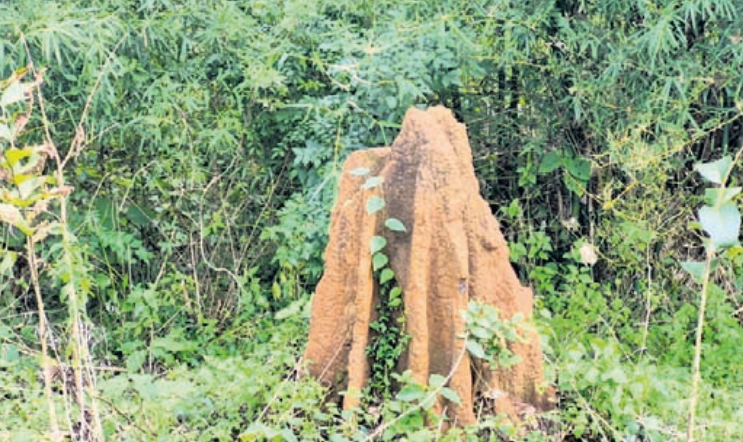
Daringbadi: Termite mounds, locally known as ui hunka and considered an important natural indicator of ecological health, are gradually disappearing from the forests of Daringbadi, triggering concern among locals and environmental observers.
Closely linked to nature and ecological balance, termite mounds play a signifi cant role in forest ecosystems. However, climate change and large-scale degradation of forest cover have led to a steady decline in their numbers.


Irregular rainfall patterns and unusual variations across summer, monsoon and winter seasons are increasingly being felt in the region, residents said.
Often referred to as the “Kashmir of Odisha,” Daringbadi is known for its pristine environment and unique geographical setting. Surrounded by hills and dense forests, the area is rich in rivers, streams, diverse fl ora and hundreds of medicinal plant species.
Traditionally, these forests were dotted with numerous termite mounds, but their presence has reduced noticeably in recent years due to deforestation and environmental stress. Termite mounds have a close relationship with climate and soil health.
Experts say they help in identifying underground water sources and serve as natural indicators of groundwater availability. The mounds are formed by termites using a mixture of soil, organic matter and saliva, making them extremely strong and durable.
Some mounds grow up to five to six feet high and provide a stable internal environment for the insects.
The structures are naturally porous, allowing air circulation while maintaining internal temperature and humidity levels, which also benefits surrounding soil conditions.
Environmentally, termites play a crucial role by breaking down decaying wood and plant material, returning essential nutrients to the soil and improving soil aeration.
Environmentalists warn that the decline of termite mounds signals deeper ecological imbalance.
Their disappearance not only affects soil fertility but may also weaken the natural groundwater recharge system, underscoring the urgent need for forest conservation and sustainable environmental practices in the region.