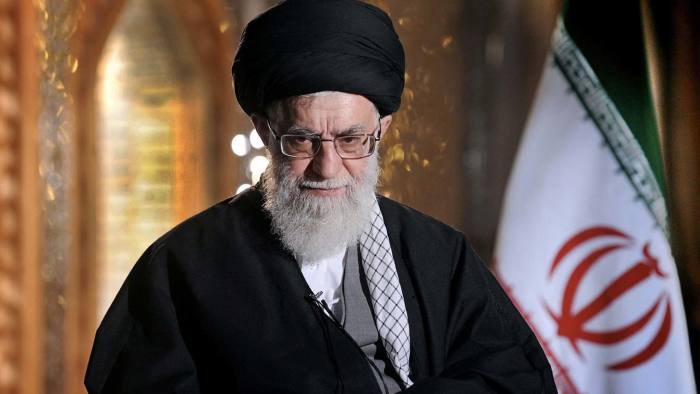
Dubai: Iran’s Supreme Leader Ayatollah Ali Khamenei Saturday branded US President Donald Trump a “criminal” for supporting protesters in Iran, and blamed demonstrators for causing thousands of deaths.
In a speech broadcast by state television, Khamenei said the protests had left “several thousand” people dead – the first indication from an Iranian leader of the extent of the casualties from the wave of protests that began December 28 and led to a bloody crackdown.


“In this revolt, the US president made remarks in person, encouraged seditious people to go ahead and said: ‘We do support you, we do support you militarily’,” said Khamenei, who has final say on all state matters. He reiterated an accusation that the US seeks domination over Iran’s economic and political resources.
“We do consider the US president a criminal, because of casualties and damages, because of accusations against the Iranian nation,” he said.
He described the protesters as “foot soldiers” of the United States and said they had destroyed mosques and educational centres. “Through hurting people, they killed several thousand of them,” he said.
Trump had sounded a conciliatory tone
His comments come a day after Trump sounded a conciliatory tone, saying that “Iran cancelled the hanging of over 800 people,” and adding that “I greatly respect the fact that they cancelled.” He did not clarify who he spoke to in Iran to confirm the state of any planned executions. His comments were a sign he may be backing away from a military strike.
In recent days, Trump had told protesting Iranians that “help is on the way” and that his administration would “act accordingly” if the killing of demonstrators continued or if Iranian authorities executed detained protesters.
In his speech, Khamenei said rioters were armed with live ammunition that was imported from abroad, without naming any countries.
“We do not plan, we do not take the country toward war. But we do not release domestic offenders, worse than domestic offenders; there are international offenders. We do not let them alone either,” he said, and urged officials to pursue the cases.
An uneasy calm
Iran has returned to an uneasy calm after harsh repression of protests that began December 28 over Iran’s ailing economy. The crackdown has left at least 3,090 people dead, according to the US-based Human Rights Activists News Agency, exceeding that of any other round of protest or unrest in Iran in decades and recalling the chaos surrounding the 1979 revolution.
The agency has been accurate throughout the years of demonstrations, relying on a network of activists inside Iran that confirms all reported fatalities. The AP has been unable to independently confirm the toll.
Iranian officials have repeatedly accused the United States and Israel of fomenting unrest in the country. On Friday, Iran’s President Masoud Pezeshkian, in a phone conversation with Russian President Vladimir Putin, accused the US and Israel of meddling in the unrest.
Reports of limited internet access briefly restored
There have been no signs of protests for days in Tehran, where shopping and street life have returned to outward normality, and Iranian state media has not reported on any new unrest.
During the unrest, authorities blocked all internet access January 8. On Saturday, text messaging and very limited internet services began functioning again briefly in parts of Iran, witnesses said.
Cellphone text messaging began operating overnight, while users were able to access local websites through a domestic internet service. Some also reported limited access to international internet services via use of a virtual private network, or VPN.
The extent of access and what was behind it wasn’t immediately. It was possible that officials were turning on some systems for the start of the Iranian working week, as the outage had affected businesses, particularly banks in the country trying to handle transactions.
Internet traffic monitoring service Cloudflare and internet access advocacy group NetBlocks reported very slight increases in connectivity Saturday morning, while Iran’s semiofficial Mehr news agency also reported limited internet access. It did not offer an explanation.
Exiled Iranian royal calls for further protests
There have been no signs of protests for days in Tehran, where shopping and street life have returned to outward normality. A call by Iran’s exiled Crown Prince Reza Pahlavi for protesters to take to the streets again from Saturday to Monday did not appear to have been heeded by Saturday afternoon.
Pahlavi, whose father was overthrown by Iran’s 1979 Islamic Revolution, enjoys support from die-hard monarchists in the diaspora but has struggled to gain wider appeal within Iran. However, that has not stopped him from presenting himself as the transitional leader of Iran if the government were to fall.
Orissa POST – Odisha’s No.1 English Daily