Ajit Ranade
India’s macro backdrop today looks unusually reassuring. Quarterly real growth has been firm, inflation is low, banks are reporting strong profits with low NPAs, and corporate balance sheets look healthier after years of deleveraging. That surface calm, however, is precisely why the Union Budget deserved to be read more as a stress test than as a celebration.


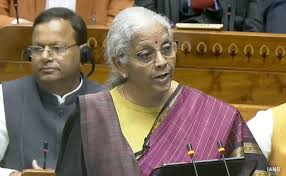
Because some of the “Gold locks” shine is contingent. Growth momentum has leaned heavily on the Union government’s public capex push, which cannot remain the default engine indefinitely without testing debt dynamics. Meanwhile, low inflation has been helped by food-price deflation, which is not permanent. The pre-Budget caution signals showed that the output of eight core industries grew only 2.6% year-on-year in April–December FY26. Finance Minister Nirmala Sitharaman presented her record ninth consecutive Budget with the theme of cautious pragmatism—trying to keep the fiscal glidepath intact while nudging the economy toward capability-building and growth enhancement.
But first, we must examine the budget numbers. Total spending is budgeted to rise to Rs 53.5 trillion, up 7.7% over revised estimates, while revenue (excluding borrowings) is projected at Rs36.5 trillion, up 7.2%. The fiscal deficit is budgeted at 4.3% of the GDP, consistent with the promise of staying below 4.5%. This restraint matters for credibili ty—especially in a world where external financing conditions can tighten abruptly and where sovereign perception can affect the cost of foreign capital.
But what about the financing environment? Between the Union government’s gross borrowing budgeted at Rs17.2 trillion and an additional Rs12.6 trillion of borrowing by States, the bond market faces a flood of issuance. Unsurprisingly, long bond interest rates are stuck at 7% despite substantial easing by the Reserve Bank of India. That becomes a deterrent to private capex.
There is also the issue of tepid revenue buoyancy. The Centre’s gross tax revenues grew only 3.3% in April–November FY26, far below the 10.8% growth as assumed for the full year. If nominal GDP this year is only 8%, or if consumption stays weak, then the best-laid fiscal arithmetic becomes harder to sustain without cutting the very capex that is propping up growth. The slight tweak to the Security Transactions Tax was as much for revenue mobilisation as for curbing excessive speculative activity in the derivatives market. But of course, the markets convulsed, and hopefully will recover soon.
On the spending side, the Budget keeps the capex bias. Capital spending on infrastructure is budgeted to rise by 9% and reach 12.2 trillion. As long as it remains high-quality capex and does not crowd out private investment, it is ok.
The Budget sets an ambitious target of achieving a 10% glob al share in services—beyond software, extending to content creation, design, health and tourism (including medical tourism). India has a comparative advantage in increasingly tradable services. This will need a productivity leap in skills.
Hence, the Budget points to the pipeline from education to employment and enterprise via a proposed standing committee. It also signals a cluster-based industrial approach—linking training institutes to sectoral clusters in textiles and leather and reviving over 200 legacy industrial clusters. The Budget’s MSME focus is welcome. Payment delays and working-capital constraints are the silent killers of small firms. Measures such as strengthening bill discounting via TReDS participation are exactly the kind of “plumbing reforms” that raise survival rates and formalisation. If the Centre’s capex push is the visible engine of growth, the private investment response remains the missing cylinder. And here the Budget missed out on a simple but effective reform. That of fixing GST input tax credits— especially for capital goods. Input tax credits on machinery, plant, equipment and construction inputs get trapped for years , which discourages capacity expansion. Firms accumulate credits that they cannot use. Full tax credit is denied because capital goods enjoy income-tax depreciation. The clean solution is to allow full tax credit on capital goods under GST while disallowing depreciation on the GST-credited portion. This was a missed reform. It has a high impact, low political cost, and reduces the cost of capital spending.
Could the Budget have been more redistributive? The FM must acknowledge an uncomfortable reality: headline growth and macro stability can coexist with widening inequality, wealth concentration, and a sense of stagnant living standards for large sections—especially when job creation is lagging.
The Budget language is heavy on “capability” and “Viksit Bharat,” but lighter on distribution: wage growth, the quality of employment, and the channels through which growth becomes broad-based consumption. The employment paradox remains stubborn—too many workers still depend on agriculture despite its much smaller share in output, a structural mismatch linked to wage stagnation and weak mass consumption. If this is not confronted more directly, the political economy risk is predictable: macro narratives will be distrusted, even when technically correct.
This is, overall, a sensible Bud get precisely because it refuses to be euphoric about a Goldilocks moment. It stays conservative on the fiscal maths, keeps capex going, and tries to orient policy toward skills and service-ex port dominance. But if India’s growth model is to become less State-driven and more private-investment-led, the next step can not be another round of headline schemes. It must be the unglamorous reforms that unclog investment and broaden participation. A push for private sector investment, and a more forthright engagement with inequality and employment quality.
While we build capabilities for growth in the future via skilling and linking clusters to training institutes, we must also ensure that the gains of growth are spread more equitably. The capability building approach should also substantially raise public spending on healthcare, education and research. That will happen only when growth pays handsome dividends to the treasury. The writer is a noted economist.
The writer is a noted economist.