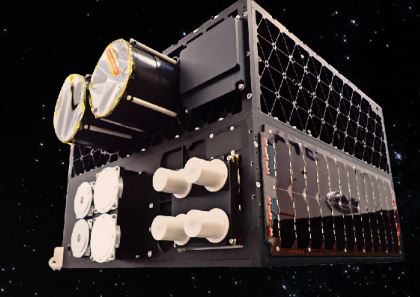
Chennai: An Indian-built private satellite, AFR, belonging to Azista Space, has captured a non-earth image of the International Space Station (ISS) while in orbit, a senior official said.
The 80-kg AFR satellite, launched in 2023, snapped images of the ISS in sunlit conditions at ranges of approximately 250 km and 300 km.


The AFR sensor was precisely tasked to track the ISS, capturing it in five distinct frames. Two independent attempts were conducted, both achieving 100 per cent success.
The acquisition resulted in images with about 2.2-metre sampling resolution, validating the company’s tracking algorithms and imaging precision.
“To our knowledge, AFR is the only Indian-built and operated satellite to have demonstrated such a feat,” the company said.
“AFR is already serving multiple customers with its imagery and remote-sensing solutions and has now successfully demonstrated non-Earth imaging (NEI) through the development of indigenous algorithms, which serve as a foundational element for the NEI and space situational awareness (SSA) electro-optical payloads designed and built for our customers. This capability is further strengthened by our upcoming electro-optical payload manufacturing facility in Ahmedabad. This achievement marks a pivotal milestone for Azista and a significant leap in India’s sovereign space preparedness,” Srinivas Reddy, Managing Director, Azista Space, said.
The images show the ISS resolved at about a 300-km range, capturing its core structure with about 2.2-metre sampling resolution. The sequence demonstrates the AFR-1 sensor’s precision during near-horizon tracking in sunlit conditions. Both raw montages and enhanced frames (colour and panchromatic) highlight the successful acquisition, Azista Space said.
“Non-Earth imaging is the need of the hour for space situational awareness. It is most important for the armed forces to determine the location of an enemy satellite,” said Bharath Simha Reddy, Assistant General Manager (AGM), Azista Space.
Azista Space also brings strong electro-optical payload, image processing and satellite bus engineering capabilities, enabling the design, development and delivery of end-to-end SSA satellites and payloads tailored to customer mission requirements.
The company remains committed to advancing indigenous SSA solutions that strengthen space safety, resilience and autonomous monitoring capabilities.
Reddy said the company was able to develop the algorithms enabling the AFR satellite to perform such imaging. According to him, the plan is to incorporate this payload feature in other satellites to be launched by the company.
AFR was launched in 2023 as a technology demonstrator. The satellite has begun generating revenue by capturing long strips of ocean imagery, about 70 km wide and 7,000–10,000 km long.
According to Bharath Simha Reddy, the images are purchased by clients in India and abroad.
Azista Space has decided to invest Rs 500 crore in setting up a space-grade electro-optical payload manufacturing facility in Sanand, Gujarat. The facility is designed to support India’s space and defence requirements.
This Rs 500 crore investment is a strategic move towards building sovereign capabilities in military-grade electro-optical payloads. The facility will play a critical role in supporting national security, space missions and advanced surveillance requirements, while positioning India among global leaders in this highly specialised domain, Srinivas Reddy had said earlier.
The upcoming electro-optical payload factory is expected to significantly enhance indigenous manufacturing of advanced electro-optical systems, reduce dependence on imports, support national and international space and defence programmes, and generate highly skilled employment.
The Azista Group is already exporting about 85 space subsystems to foreign customers.
UNI