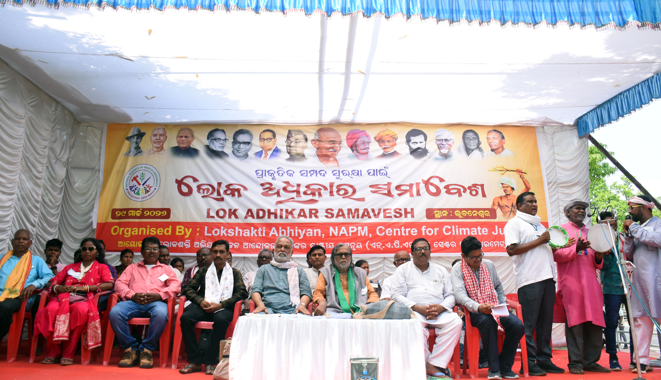
Bhubaneswar: Lok Adhikara Samabesh, organised by Lok Shakti Abhiyan, National Alliance of People’s Movements (NAPM), and Centre for Climate Justice, marked the culmination of the ‘Loka Adhikara Yatra’ at Lower PMG Sunday.
On this occasion, a manifesto proposing an alternative, people-centric development model was released.


Leaders at the convention appealed to the state government, political parties and various sections of the society to deliberate on this alternative policy framework.
The manifesto outlines several major demands, including publication of a white paper on the status of natural resources in the state, ban on indiscriminate mining and protection of bauxite reserves, no new coal mining or thermal power projects, promotion of small and medium industries based on agriculture and forest produce, legal guarantee for fair prices to farmers, end to forced land acquisition, protection of democratic movements from state repression, implementation of forest rights for tribal and traditional forest dwellers, land distribution to landless farmers, improved rural employment, education, and healthcare systems, strong measures to control pollution and protect rivers and formation of constitutional bodies for justice to displaced people.
The conference witnessed the participation of thousands of people, activists across the state.
The gathering strongly opposed the exploitation of natural resources in the name of development and accused corporate entities of looting the state’s resources.
Leaders at the convention declared that the struggle to protect nature, the environment, land, and the livelihoods of people will continue.
They emphasised that indiscriminate extraction of natural resources is destroying ecosystems, livelihoods, and pushing the state toward resource depletion.
The meeting, coordinated by NAPM Odisha convener Narendra Mohanty, was addressed by prominent environmentalist Prafulla Samantara, farmer leader Lingaraj, Gandhi Peace Foundation representative Biswajit, and social activist Kalyan Anand, among others.
Speakers highlighted that people’s movements are essential to protect land, water, forests, and natural resources.
They described the yatra and the convention as a milestone in strengthening grassroots resistance and democratic struggles.
Several intellectuals, activists, political leaders, and representatives of people’s movements expressed solidarity with the manifesto.
They stressed the urgent need to safeguard constitutional rights and ensure sustainable development.
Leaders from various grassroots movements shared their struggles against mining, industrial expansion, and displacement, calling for broader public support to protect the environment and livelihoods. Activists who have been fighting for environmental protection despite facing legal challenges and imprisonment were also felicitated at the event.
The convention also featured cultural performances, including awareness songs by activist groups, reinforcing the message of resistance and environmental protection.
The convention concluded with a strong call for a sustained, united struggle to protect natural resources, democratic rights, and livelihoods, while advocating for a more just and sustainable development model in Odisha.