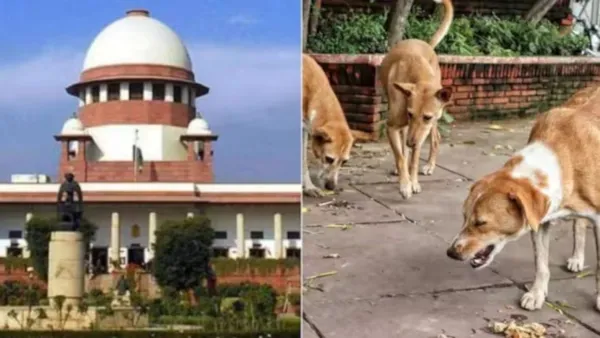
Love is a supreme feeling that brings unalloyed joy to the one who gives it and also to the one who receives it. This feeling prompts man to embrace animals as their own and shower compassion on them. But misplaced and misdirected love may bring miseries, leading even to death. This is exactly what is happening in the country now, with the menace of stray dogs biting children, elderly people and the general public, which seems to be assuming alarming proportions. Feeding such hapless dogs has become almost fashionable with many dog lovers vaunting their care and compassion for the quadruped as a status symbol.
The Supreme Court on 19 May acted correct to dismiss applications challenging the standard operating procedure (SOP) devised by the Animal Welfare Board of India (AWBI) in November last year, in line with its previous directions in the case of stray dogs.
Also Read


The Apex Court had then directed all states and Union Territories to remove stray dogs from the premises of educational institutions, hospitals, sports complexes, bus stands and depots and railway stations, “to a designated shelter, after due sterilisation and vaccination in accordance with the Animal Birth Control Rules.”
Dismissing the challenge to the SOP, a Bench headed by Justice Vikram Nath and comprising Justices Sandeep Mehta and NV Anjaria categorically stated that it finds no reason whatsoever to interfere with the SOP. The challenge made to the SOPs, both on the grounds of the alleged excess of jurisdiction as well as on the basis of the inconsistency with the statutory scheme, does not merit acceptance, the Court held. The court issued a slew of directions mandating states and Union Territories to take decisive and coordinated time-bound steps for enhancing the infrastructure necessary for the effective implementation of the animal birth control framework, including the expansion of sterilisation and vaccination capacity, strengthening of existing facilities and creation of additional institutional mechanisms commensurate with the scale and urgency of the issue. The general tendency shown by state governments and civic bodies across the country is to treat the menace of stray dogs perfunctorily. Drives against such dogs roaming in streets, lanes and bylanes causing alarm to children, the aged and people in general are sporadic in some cases and non-existent in most.
Of late some animal lovers have developed the habit of feeding stray dogs at random places exposing people to further risks. The Apex Court had in November last year banned the feeding of dogs in streets, except in designated feeding spots. But the ban has so far had no deterrent effect at all. It also passed directions to the authorities to ensure the removal of stray dogs from public places such as schools, hospitals, bus stands, railway stations and sports complexes. Dogs must be shifted to shelters and must not be released back to the same place from where they were picked.
Later, several applications were filed by dog lovers and animal rights groups to recall these directions. After elaborately hearing these applications, the Bench reserved judgment on 29 January.
The Court rightly took state authorities to task for their nonchalant attitude to the menace and their disinterest in protecting the lives of citizens from dog attacks. It noted that Article 21 necessarily encompasses the right of every citizen to move and access public places without living under a constant apprehension of physical attack or exposure to life-threatening events such as dog bites in public areas. It was high time that the Supreme Court came down heavily on state administrations that cannot remain a passive spectator where preventable threats to human life continue to proliferate despite the existence of statutory mechanisms designed to address the problem. Stray dogs may not truly be the problem, but the administration charged with managing citizens’ safety is.