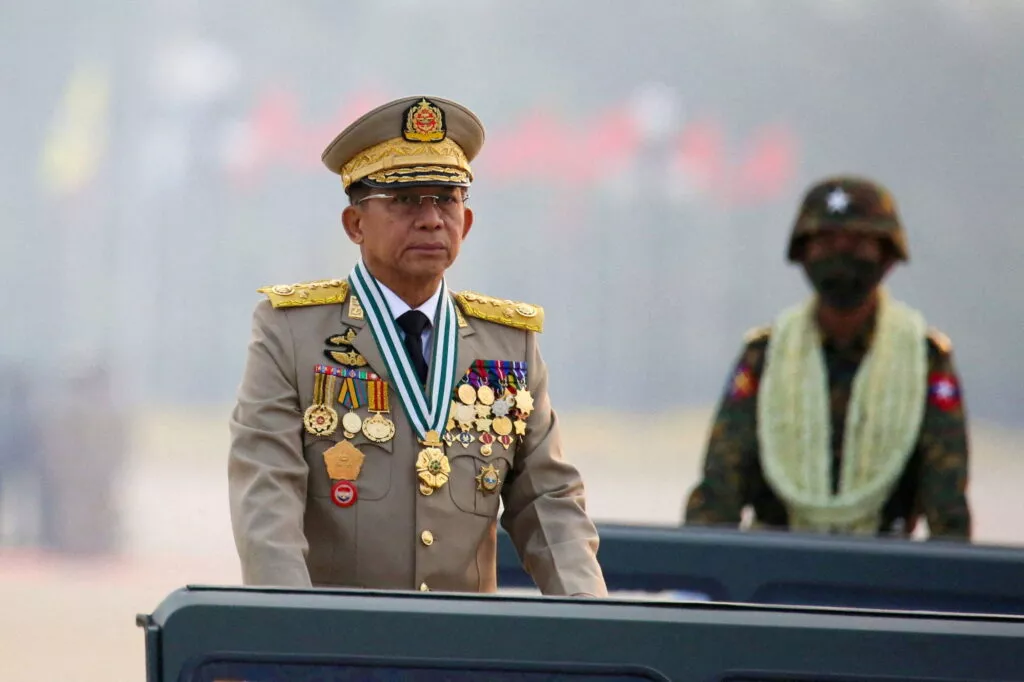
While a big war is being waged in the Middle East, global attention has moved away from another theatre of genocidal war and ethnic cleansing. The perpetrators are taking full advantage of the situation. Myanmar’s military chief Min Aung Hlaing has been nominated for the presidency as parliament convened 30 March following what is being seen as a sham general election from which the biggest Opposition parties were excluded. Hlaing is certain to be chosen, as he was nominated in parliament alongside two loyalists who are very unlikely contenders for President. He has been sanctioned by many Western countries for leading a military coup five years ago. The country’s upper House will also nominate a vice-presidential candidate, with both Houses to select a President from the three in a later vote. A date for that vote has not been announced.
The controversial election was held in December and January amid raging conflict and the military-backed Union Solidarity and Development Party won. But it was widely mocked at by the United Nations and many Western countries. Myanmar has been witnessing violence since the 2021 coup in which the military, known as the Tatmadaw, did not allow the democratically elected government of Nobel Peace Prize winner Aung San Suu Kyi to take charge.
Also Read

As per the country’s constitution, only civilians can qualify for the presidential post. For this reason Hlaing handed over the position of commander-in-chief of the armed forces to his die-hard loyalist Ye Win Oo, a veteran officer. Ye Win Oo was appointed Myanmar’s intelligence chief in 2020 and was promoted to commander-in-chief of the army earlier this month. His double promotion in such a short span of time clearly demonstrates the confidence Hlaing reposes on him. There are some risks for Hlaing after he relinquishes his army position since he will have no direct say in the affairs of the military. But the risk is worth taking since the junta under his loyalist will still be running the show and bombing civilians, while he can have the pretence of being an elected leader of the country. He had long set his eyes on becoming the country’s President, even though Myanmar’s raging civil war has severely damaged the military’s prestige. Large areas of the country remain under the control of armed opposition groups. Despite the claim by the junta that the recent general elections were a pathway to peace, the vote was widely regarded as a mockery of democracy, with many popular parties banned from contesting and large areas of the country not allowed to participate in voting because of the civil war. The Israel-US war against Iran has overshadowed the sufferings of the people in Myanmar where estimates put the number of people killed by the junta since 2021 as 93,000 or more, while the UN says that 3.6 million are displaced. The unpopularity of the junta became clear in the 2020 election when the party floated by it won just 6 per cent of the vote.
However, things appeared to be turning favourable for the junta recently following fractures within opposition forces comprising fighters aligned with the exiled National Unity Government, ethnic armed groups and other resistance organisations. Myanmar stands out as an example of rule by military forces with an iron hand and resistance groups trying to use the country’s natural resources and provide services to the people. While the generals want a veneer of democracy to ease international pressure, opposition-run local administrations have not yet given up on democracy even though they are increasingly becoming battle-weary.
In such a situation, the outside world needs to pile pressure on the junta and not to be distracted for far too long by other events of equally great importance.