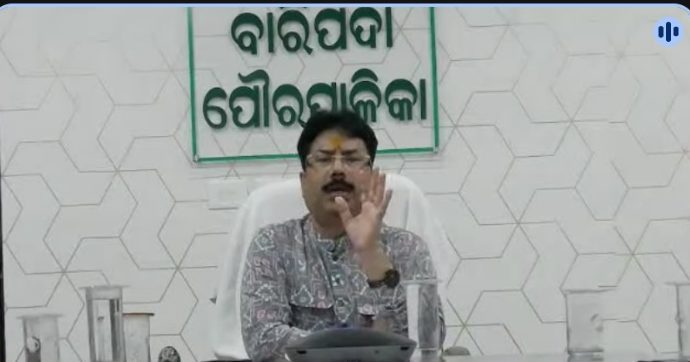
Bhubaneswar: Housing and Urban Development (H&UD) Minister Krushna Chandra Mahapatra Friday advised urban local bodies (ULBs) across Odisha to reduce dependence on conventional revenue sources and prepare action plans to achieve at least 50 per cent self-sustainability through innovative revenue-generation mechanisms.
Joining a virtual review meeting of commissioners and executive officers of ULBs, Mahapatra issued a series of strategic directives aimed at strengthening urban governance and administrative accountability. Stressing proactive urban management, the minister directed ULBs to undertake immediate drainage cleaning and intensify sanitation measures to prevent waterlogging during the monsoon.


He also instructed officials to prepare a uniform design blueprint for welcome gates in all newly declared Notified Area Councils (NACs) to establish a distinct urban identity. Emphasising financial sustainability, Mahapatra said ULBs should “reduce dependence on conventional revenue sources and prepare action plans to achieve at least 50 per cent self-sustainability through innovative revenue-generation mechanisms.”
To enhance institutional accountability and administrative efficiency, he directed the immediate implementation of a digitised personnel database and mandatory monthly progress reporting systems for all ULB staff.
H&UD department Additional Chief Secretary Usha Padhee, who chaired the meeting, outlined a transformative vision for the state’s urban future and stressed the importance of responsive, transparent, accountable and citizen-centric governance. She called for convergence of sanitation, waste management, housing, water supply, green infrastructure and Smart City initiatives under an integrated urban development framework aligned with Odisha’s long-term growth vision.
Highlighting new opportunities under the Centre’s Urban Challenge Fund, with an outlay of Rs 1 lakh crore, she urged ULBs to strengthen project preparedness, innovation and institutional capacity to secure competitive funding support. She also advised urban bodies to explore institutional finance, public-private partnership (PPP) models and credit-linked financing mechanisms to accelerate infrastructure development.
Municipal Administration Director Arindam Dakua discussed revenue augmentation measures, assessment systems and performance report cards for ULBs. Discussions also focused on improving own-source revenue generation and strengthening financial sustainability.
The importance of waterbody rejuvenation and urban ecological restoration was also highlighted. The post-lunch session focused on the SAHAJOG initiative and ‘waste-to-wealth’ strategies for scientific waste management and resource recovery.
Discussions emphasised community participation, behavioural change and sus tainable waste-processing systems for cleaner urban centres. Urban sanitation programmes, including solid waste management, liquid waste management and GARIMA, were extensively reviewed.
The meeting assessed ULB performance in maintaining sanitation standards and discussed measures to improve waste segregation, scientific disposal and welfare support for sanitation workers.