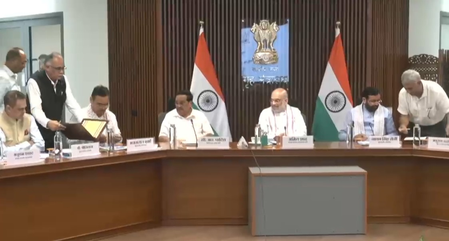
New Delhi: After 32 years, an agreement was signed between Haryana and Rajasthan Monday regarding the Yamuna Water Project under the chairmanship of Union Home Minister Amit Shah.
Union Jal Shakti Minister C.R. Patil, Haryana Chief Minister Saini and his Rajasthan counterpart Bhajanlal Sharma were present on the occasion.

Addressing the gathering, CM Saini said that a series of meetings had been held between Haryana and Rajasthan under the chairmanship of the Union Jal Shakti Minister regarding the project.
Under the MoU, Rajasthan will utilize the surplus rainwater available in Haryana between July and October through a dedicated pipeline for drinking water purposes.
“The agreement marks a significant step forward in the implementation of the project,” he said and added that a pipeline will be laid from the Hathnikund Barrage to Rajasthan to facilitate the use of surplus water.
CM Saini said, “It is a matter of great satisfaction, as ensuring the supply of water to those in need is a shared responsibility.”
He assured full cooperation from Haryana and stated that no obstacle would be allowed to hinder the implementation of the project.
The Chief Minister further said that prior to the signing of the MoU, various aspects of the project had been discussed in detail under the leadership of the Union Jal Shakti Minister.
The agreement was finalised after extensive deliberations on all related issues.
CM Saini expressed his gratitude to HM Shah, Patil, and Sharma for facilitating the agreement.
The Rajasthan Chief Minister called it a historic day. He said the agreement “marks a major step towards supplying the Yamuna water to the three districts of Shekhawati region and will end a wait of several decades”.
The first agreement to supply the Yamuna water to Shekhawati was signed between Rajasthan and Haryana in 1994. However, the project remained on paper because both states could not reach a consensus.
In 2001, it was again decided that Rajasthan would receive water from Haryana’s Hathinikund Barrage, but the project did not move forward. The process was revived in 2024.